



- All
- Aerospace Assembly
- AIRCRAFT CABLE
- ARCHITECTURAL AND INDUSTRIAL LIGHTING
- ARCHITECTURAL RAILING AND HARDWARE
- AUTOMOTIVE
- BOLT SNAP AND SNAP HOOKS
- BUNGEE CORDS
- BUTTON STOP
- clevises-yoke-ends
- CLIP AND CLAMPS
- CUSTOM PUSH PULL ASSEMBLIES
- CUTTING AND SWAGING TOOLS
- CUTTING WIRE ROPE
- DFARS
- DIE CAST FITTINGS
- DOMESTIC AND USA
- EYE BOLTS
- EYE ENDS
- FITNESS CABLE
- FORK and JAW ENDS
- GENERAL QUESTIONS AND POLICIES
- Hook Faqs
- HOOKS
- KWIK LOCS
- NYLON CABLE TIES
- Ped Eyes Faqs
- PLAIN BALL
- PRESTRESSED ASTM A1023
- PROOF-LOADING
- PULL TESTING
- PULLEYS
- PUSH-PULL CONTROLS
- QUALITY AND ENGINEERING
- QUICK LINKS
- RIGGING TURNBUCKLES
- ROUND RINGS AND D-RINGS
- S – STAINLESS STEEL
- SHACKLES
- Shackles Faqs
- SLEEVES
- SNACK BALLS
- SPELTER SOCKETS
- STAMPED EYES
- STRAND
- STRAP FORKS, EYE ENDS, AND FORK ENDS
- STRUCTURAL HARDWARE
- STUD AND THREADED PLUGS
- SWAGED CABLE
- SWAGLESS MECHANICAL FITTINGS
- SWEGELESS FITTINGS
- SWIVEL SLEEVES
- SWIVELS
- THIMBLES
- THIMBLES WIRE ROPE
- TITLE CLAMPS
- Tools Faqs
- TURNBUCKLE
- Turnbuckles
- VINYL AND NYLON-COATED CABLES
- WIRE ROP HARDWARE TOOL
- WIRE ROPE
- WIRE ROPE CLIPS
- Wire Rope Corrosion
- Wire Rope Faqs
Wire hardware refers to the components used to secure, connect, tension, and assemble wire rope or cable systems, including clips, thimbles, turnbuckles, and hooks
Common types include clips and clamps, thimbles, shackles, hooks, turnbuckles, and connectors used for rigging and attachment.
Selection depends on load requirements, cable size, connection type, and environmental conditions such as exposure to moisture or corrosion.
Yes. Stainless steel and corrosion-resistant materials are commonly used for outdoor and marine applications.
Yes. Lexco provides fully integrated cable and hardware solutions to ensure compatibility and reduce installation time.
A forked end fitting is a wire rope termination with two parallel sides that connect to a mating tab or bracket using a pin. It creates a secure connection while allowing controlled movement at the cable end.
Fork ends and jaw ends serve similar functions and both create pin-connected cable terminations. Specific fittings may differ in jaw width, pin size, material, swage configuration, and overall geometry.
Forked ends can provide greater strength and reliability due to direct swaging and reduced component complexity.
Commercial-grade fittings typically include pins, while MIL-SPEC fittings often require pins to be ordered separately.
Yes. Lexco can manufacture complete wire rope and aircraft cable assemblies with fork ends, jaw fittings, swage forks, open swage sockets, and related fittings installed to the required dimensions.
A Bowden cable is a flexible cable system that transmits mechanical motion using an inner wire and outer sheath, commonly used in push pull cable assemblies.
They are used in applications requiring controlled mechanical motion, including automotive systems, industrial machinery, marine controls, and agricultural equipment.
Push pull cables transmit force in both directions, while pull-only cables are designed to operate in one direction only.
Yes. Lexco manufactures fully custom cable assemblies based on your required dimensions, loads, and performance conditions.
Custom cable assemblies provide better fit, improved durability, enhanced performance, and longer lifespan compared to standard cables.
A wire rope ball end is a spherical fitting permanently attached to wire rope or aircraft cable to create an anchor, stop, or positioning point.
Shank balls are used to anchor cable assemblies or create fixed positioning points along a wire rope.
Yes. Shank ball fittings are rotary swaged onto the cable to create a permanent connection and maintain the required ball dimensions.
Common options include stainless steel for corrosion resistance and zinc-plated steel for general applications.
Yes. Lexco provides fully assembled cable systems with ball end fittings installed to ensure consistency and reduce installation time.
A mechanical control cable is a flexible system used to transmit motion or force between components in a machine or system.
A push pull control cable transmits force in both directions, enabling controlled mechanical movement in systems such as throttle or gear controls.
They are used in automotive, industrial, marine, agricultural, and specialty mechanical systems requiring remote actuation or motion control.
Yes. Lexco manufactures fully custom mechanical control cables tailored to specific performance, length, and environmental requirements.
Common materials include carbon steel and stainless steel, along with specialized liners and coatings depending on application needs.
Steel cable ends are fittings attached to the ends of wire rope or cable to enable secure connection, load transfer, or system integration.
Wire rope fittings is a broader category that includes all hardware used with wire rope, while cable ends specifically refer to termination fittings attached to the ends of the cable.
Common types include swaged fittings, swageless fittings, threaded studs, eye ends, fork ends, and ball terminals.
Selection depends on load requirements, environment, connection type, and whether the installation is permanent or field-adjustable
Yes. Lexco manufactures fully assembled wire rope systems with pre-installed cable ends to ensure precision, consistency, and reduced installation time.
Shank balls are used to create an anchor point, stop, or locating feature along a wire rope or aircraft cable assembly. Unlike some cable end fittings that are installed only at the end of the cable, shank balls can be positioned at intermediate points along the wire rope for specialized applications.
Single and double shank balls differ in fitting geometry and application requirements. Lexco offers MS20664 single shank balls and MS20663 double shank balls for different cable assembly configurations.
Yes. Ball and shank ball fittings must be rotary swaged to the cable to help achieve proper strength and spherical dimensions. Rotary swaging helps secure the fitting to the wire rope and supports consistent performance in custom cable assemblies.
Yes. Shank balls can be used with aircraft cable assemblies when the application requires a ball-style anchor, stop, or locating feature. Compatibility depends on the aircraft cable diameter, cable construction, fitting material, load requirements, and the design of the mating component.
When requesting a quote, provide the cable diameter, wire rope or aircraft cable construction, shank ball type, material, required location on the cable, quantity, load requirements, and application details. If available, include drawings, photos, specifications, or part numbers so Lexco can recommend the correct shank ball fitting or custom cable assembly.
Eye ends create secure attachment points at the end of wire rope, aircraft cable, or custom cable assemblies. Depending on the fitting style, they can connect to pins, hooks, shackles, clevises, brackets, and other hardware.
Lexco Cable offers several eye end fitting options, including stamped eyelets, marine eyes, MS20668 eye ends, strap eyes, ring eyes, pin eye terminals, closed swage sockets, closed strap clevises, and light duty ring terminals. The right option depends on the cable size, connection style, load requirements, specification needs, and application environment.
Choose the fitting based on cable diameter and construction, required load, eye dimensions, mating hardware, material, environmental exposure, and any applicable commercial or military specifications.
Yes. Eyelets, MS20668 eye ends, strap eyes, ring eyes, and other eye end fittings can be used with aircraft cable assemblies when matched to the required cable diameter, load, and specification.
When requesting a quote, provide the cable diameter, wire rope or aircraft cable construction, eye end style, material, required assembly length, load requirements, specification requirements, and application environment. If available, include drawings, photos, part numbers, or military/commercial specifications so Lexco can recommend the right eye end fitting or custom cable assembly.
Plain balls are used to create ball ends on wire rope and aircraft cable assemblies. They can function as cable stops, locating points, retention features, or compact attachment ends. They are commonly used in custom wire rope assemblies, control cables, OEM equipment, and industrial cable applications.
Plain balls are commonly used to create wire rope ball ends. Once installed on the cable, they provide a rounded end fitting that can seat into a compatible slot, socket, bracket, or mating component. The exact use depends on the cable assembly design and application requirements.
Plain balls are available in stainless steel, brass, and steel plated options. The right material depends on the cable type, environment, corrosion resistance needs, strength requirements, and how the ball end will interface with surrounding hardware.
Yes. Plain balls can be used with aircraft cable assemblies when the design requires a compact ball end or cable stop. Compatibility depends on the cable diameter, cable construction, fitting material, load requirements, and the mating component the ball end will connect with.
When requesting a quote, provide the cable diameter, wire rope or aircraft cable construction, plain ball material, ball size, quantity, load requirements, and application details. If available, include drawings, photos, specifications, or part numbers so Lexco can recommend the correct ball end fitting or custom cable assembly.
Wire rope thimbles are used to protect looped cable ends from wear, fraying, and abrasion at the bearing point. They sit inside the eye of a wire rope or aircraft cable assembly and help reduce direct contact between the cable and connecting hardware such as hooks, shackles, eye bolts, or clevises.
Yes. Wire rope thimbles are typically used with sleeves or wire rope clips to form a secure loop end. The thimble protects the loop, while the sleeve or clip holds the wire rope in place. The correct combination depends on the cable diameter, application, load requirements, and installation method.
Galvanized thimbles are commonly used for general-purpose wire rope applications and provide corrosion resistance in many standard environments. Stainless steel thimbles offer stronger corrosion resistance and are often preferred for outdoor, marine, architectural, or corrosive environments. The right choice depends on where and how the cable assembly will be used.
Yes. Thimbles can be used with aircraft cable assemblies when a looped cable end needs added protection from friction, bending, or wear. They are commonly paired with sleeves or wire rope clips to create durable eye ends for aircraft cable, wire rope, and custom cable assemblies.
When requesting a quote, provide the wire rope or aircraft cable diameter, thimble material, quantity, application, load requirements, and whether the thimble will be used with sleeves or wire rope clips. If available, include drawings, specifications, photos, or part numbers so Lexco can recommend the correct thimble or custom wire rope assembly.
Wire rope clips are used to create loop ends in wire rope and aircraft cable assemblies, particularly for field installations where the loop needs to form without swaging equipment. Common applications include rigging, suspension, industrial cable systems, safety cables, and custom wire rope assemblies.
Yes. Wire rope clips are often called wire rope clamps, and the terms are commonly used interchangeably. Both typically consist of a U-shaped bolt, a saddle, and two nuts that clamp the wire rope in place, though specific styles vary by application, material, and performance needs.
Drop forged wire rope clips are typically stronger and are often preferred for load-bearing or heavy-duty applications, while malleable wire rope clips suit lighter-duty or non-critical uses. Selection depends on cable diameter, load requirements, environment, and application criticality.
Yes. Stainless steel wire rope clips, especially Type 316 stainless steel, are often used for outdoor, marine, architectural, and corrosive environments because they offer improved corrosion resistance. Galvanized wire rope clips may also be used outdoors, depending on the exposure level and application requirements.
When requesting a quote, provide the wire rope diameter, cable construction, clip or clamp style, material preference, quantity, load requirements, and application environment. If available, include drawings, specifications, photos, or part numbers so Lexco can recommend the correct wire rope clip, clamp, or custom cable assembly.
Wire rope sleeves form loop ends, or eyes, on wire rope, aircraft cable, and fiber rope assemblies. They’re often installed with a thimble to reinforce the loop and are commonly used in rigging, lifting, industrial, architectural, and custom cable assemblies that need a secure attachment point.
A sleeve is swaged or compressed onto the cable to hold the loop in place, while a thimble sits inside the loop to protect the wire rope from abrasion, crushing, or sharp bending. Sleeves and thimbles are frequently used together to create a stronger, more durable loop end.
The right sleeve material depends on the cable type, environment, load requirements, and intended use. Stainless steel sleeves offer strong corrosion resistance, aluminum sleeves suit compatible wire rope constructions, and copper or zinc-plated copper sleeves are common for aircraft cable and general-purpose assemblies.
Many sleeves are designed to hold the nominal breaking strength of compatible wire rope when properly selected and installed. Performance depends on the sleeve type, cable construction, cable diameter, material compatibility, swaging method, and application. For critical or load-sensitive applications, testing or proof-loading may be recommended.
When requesting a quote, provide the cable diameter, wire rope or aircraft cable construction, sleeve material, sleeve style, required loop size, whether a thimble is needed, load requirements, and application environment. If available, include drawings, specifications, photos, or part numbers so Lexco can recommend the correct sleeve or custom wire rope assembly.
Die-cast wire rope fittings are cable end fittings formed by injecting molten zinc onto the end of a cable inside a custom die. This process is used to create custom shapes such as barrels, bullets, ball ends, eyelets, Z-shapes, L-shapes, and other specialty wire rope or cable end fittings.
Die-cast fittings are a good option when the application calls for a custom cable end shape or high-volume, repeatable production. Swaged fittings are often used for standard wire rope terminations, while die-cast fittings suit specialized shapes or larger production runs where tooling costs can be offset by volume.
Yes. Lexco Cable manufactures die-cast fittings to customer specifications, including ball ends, eyelets, barrels, bullets, and Z- and L-shaped fittings for wire rope and aircraft cable assemblies.
Die-cast fittings can be cost-effective for high-volume custom wire rope assemblies because they may reduce labor compared to conventional swaging or machined fittings. Most die-cast fittings are made to order and may require a tooling fee, so they are often best suited for production runs where volume can offset the initial tooling cost.
When requesting a quote, provide the cable diameter, wire rope or aircraft cable construction, desired fitting shape, dimensions, material requirements, quantity, load requirements, and application details. If available, include drawings, samples, photos, specifications, or part numbers so Lexco can evaluate the design and quote the appropriate custom die-cast fitting.
Marine rigging turnbuckles are used to tension wire rope and cable assemblies in marine, architectural, and high-strength applications. They help adjust cable tension and alignment while creating a secure connection between the cable and surrounding hardware, and they’re commonly used in marine rigging, architectural cable railing, and custom wire rope assemblies.
Marine rigging turnbuckles are typically built for higher-strength, corrosion-resistant applications and are often made from stainless steel. Many are machine swaged directly onto the cable for a cleaner, integrated connection, while standard turnbuckles are more often used for general-purpose tensioning.
Lexco Cable offers eye-eye, eye-hook, hook-hook, eye-jaw, hook-jaw, and jaw-jaw tubular turnbuckle configurations, along with open body turnbuckles, marine toggle jaws, marine eye ends, and separate turnbuckle bodies. The right configuration depends on the attachment points, load requirements, and installation method.
Yes. Marine rigging turnbuckles are similar to cable railing turnbuckles and may be used in architectural cable railing systems where a strong, tensioned cable connection is needed. Stainless steel turnbuckles are commonly preferred for cable railing hardware because they offer corrosion resistance, durability, and a clean finished appearance.
When requesting a quote, provide the wire rope or cable diameter, turnbuckle style, end configuration, material preference, required assembly length, tensioning requirements, load requirements, and application environment. If available, include drawings, photos, specifications, or part numbers so Lexco can recommend the right turnbuckle or custom wire rope assembly.
Cable jointers create adjustable loops in aircraft cable for suspending static loads. Common uses include lighting, signage, gallery and retail displays, ductwork, cable trays, sound systems, CCTV cameras, and other secondary support applications.
A Kwik-Loc is a wire rope fitting that creates a field-installed loop in aircraft cable without traditional swaging equipment. It’s available in several sizes to match different cable diameters and load requirements.
Selection depends on cable diameter and the safe working load required for the application. Smaller sizes such as the KL50 and KL75 suit lightweight signage and lighting, while larger sizes such as the KL200 and KL600 are built for heavier loads and higher safe working load limits.
Yes. Cable jointers are commonly used for overhead suspension of static loads, including lighting, ducts, cable trays, and displays. The correct cable jointer must be selected based on the cable diameter, load requirements, and installation conditions. For critical or load-sensitive applications, it is important to confirm compatibility before installation.
When requesting a quote, provide the aircraft cable diameter, required Kwik-Loc size if known, suspended load weight, application type, installation environment, and any required hardware or cable assembly details. If available, include drawings, photos, specifications, or part numbers so Lexco can recommend the right cable jointer or aircraft cable assembly.
Swageless fittings create secure wire rope terminations without conventional swaging equipment. They are commonly used for field installation, repairs, maintenance, cable railing, lifeline systems, and custom cable assemblies.
Swaged fittings are compressed onto wire rope using specialized equipment. Swageless fittings use a mechanical connection that can typically be assembled without conventional swaging machinery.
Yes. Many swageless fittings are available for use with stainless steel wire rope as well as galvanized and other cable materials. Compatibility depends on the wire rope construction, cable diameter, fitting style, and application requirements. Lexco can help identify the correct swageless fitting for your cable assembly.
Choose the fitting based on wire rope diameter and construction, end connection, material, load requirements, and installation environment. Providing the full wire rope specification helps confirm compatibility.
When requesting a quote, provide the wire rope diameter, cable construction, material, fitting type, load requirements, application, and any required thread sizes or connection styles. If available, include drawings, specifications, or part numbers so Lexco can recommend the appropriate swageless fitting or custom wire rope assembly.
Spelter sockets create permanent, high-strength end terminations for wire rope and aircraft cable assemblies. They’re commonly used for lifting, structural, bridge, anchoring, and other heavy-duty applications that require a socketed cable end connection.
Open spelter sockets have an open connection point for pinning to a shackle, clevis, or bracket, while closed spelter sockets form an enclosed eye-style connection. The right choice depends on the mating hardware, load requirements, and installation method.
Yes. Spelter sockets can be used for wire rope and aircraft cable terminations that require a permanent, socketed end connection. Selection depends on cable diameter, construction, load requirements, and application environment.
Proof-loading is recommended for critical applications such as overhead lifting, structural use, and other applications where assembly performance needs to be verified. When requesting a spelter socket assembly, customers should specify whether proof-loading is required so the assembly can be quoted and produced accordingly.
When requesting a quote, provide the wire rope or aircraft cable diameter, cable construction, socket type, required assembly length, load requirements, application environment, and whether proof-loading is needed. If available, include drawings, specifications, photos, or part numbers so Lexco can recommend the right spelter socket or custom wire rope assembly.
Swivel sleeves are wire rope fittings used when a cable assembly needs a threaded connection point with added rotational flexibility. They can help the fitting align with attached hardware during installation or use, making them helpful for custom wire rope assemblies, aircraft cable assemblies, industrial cable systems, and other applications where connection alignment matters.
Hex swivel tapped sleeves usually have a hex-shaped body that can make installation or tightening easier with a tool. Round swivel tapped sleeves have a smoother round profile, which may be preferred where space, appearance, or clearance matters. Male-threaded swivel sleeves include an external threaded end for connecting to compatible cable hardware or mounting points.
The right swivel sleeve depends on the cable diameter, wire rope construction, thread type, fitting shape, available clearance, load requirements, and how the assembly will connect to surrounding hardware. Lexco can help match the correct swivel sleeve to your custom wire rope assembly based on the application and required connection style.
Yes. Swivel sleeves may be used with aircraft cable assemblies when the application requires a threaded cable end fitting with alignment flexibility. The correct fitting depends on the aircraft cable size, cable construction, material requirements, load expectations, and the hardware the assembly needs to connect to.
When requesting a quote, provide the cable diameter, wire rope or aircraft cable construction, preferred swivel sleeve style, thread size, material, finish, required assembly length, load requirements, and application environment. If available, include drawings, photos, specifications, or part numbers so Lexco can recommend the right cable fitting or custom wire rope assembly.
Threaded studs create permanent threaded cable ends that allow wire rope or aircraft cable assemblies to connect to nuts, brackets, clevises, tensioning hardware, and other threaded components.
Threaded studs generally provide a longer threaded section for permanent cable terminations. Threaded plugs are typically shorter and more customizable, making them useful where installation space is limited.
Choose the fitting based on wire rope diameter and construction, required holding strength, thread size and pattern, material, mating hardware, corrosion exposure, and available installation space.
Yes. Lexco Cable can supply custom wire rope fittings, including threaded studs and threaded plugs with specific materials, thread patterns, finishes, swage dimensions, and application requirements. Custom options may include stainless steel, carbon steel, zinc plated, galvanized, UNC, UNF, and other fitting specifications depending on the application.
When requesting a quote, provide the cable diameter, wire rope construction, fitting type, material, thread size, thread pattern, finish, required assembly length, load requirements, and application environment. If available, include drawings, specifications, photos, or part numbers so Lexco can recommend the right wire rope fitting or custom cable assembly.
MIL-DTL-83420 is a military specification for flexible aircraft cable used in aerospace and defense applications. It includes galvanized and stainless steel options, jacketed and non-jacketed configurations, and 3×7, 7×7, and 7×19 constructions in specified diameter ranges.
No. Lexco does not manufacture or strand MIL-DTL-83420 cable. Lexco uses certified MIL-DTL-83420 aircraft cable to fabricate complete custom assemblies. Lexco also sells MIL-DTL-83420 aircraft cable by the foot, on reels, or in pre-cut pieces.
Lexco’s applicable aerospace and defense work is focused on non-flight-critical assemblies. These may include maintenance equipment, manufacturing fixtures, lifting systems, ground-support equipment, lanyards, tethers, and other specialized mechanical assemblies.
A drawing or physical sample is the best starting point. Buyers should also provide the cable specification, construction, diameter, material, finished length, tolerances, coating, fittings, testing requirements, documentation needs, quantities, and requested delivery schedule.
Yes, depending on the project requirements. Available processes may include proof loading, prestretching, dimensional inspection, material traceability, certificates of conformance, inspection reports, and test documentation. Lexco can also provide AS9102 First Article Inspection reporting when requested.
Yes. Galvanized wire rope resists rust through its zinc coating, but it is not completely rust-proof. Once the zinc coating wears or corrodes, the underlying carbon steel can begin to rust.
Type 316 stainless steel is generally preferred for saltwater, coastal, and chloride-heavy environments because it provides greater corrosion resistance than galvanized steel.
Visible rust, pitting, stiffness, reduced flexibility, and broken outer wires can indicate corrosion-related damage. Wire rope showing these signs should be inspected before continued use.
Yes. Lexco can manufacture custom push-pull cable assemblies for PTO and other mechanical control applications based on required cable length, travel distance, load, mounting configuration, and operating environment.
Automotive control cables are used to transfer mechanical motion between controls and vehicle components. Depending on the application, they may be used for throttle, brake, clutch, transmission, and other remote actuation systems. Lexco can manufacture custom control cable assemblies to meet specific travel, load, routing, mounting, and environmental requirements.
Wire rope turnbuckles are used to adjust the tension or length of wire rope and aircraft cable assemblies attached to structures. They’re commonly used in rigging, architectural cable railing, marine, and general industrial tensioning applications.
A complete turnbuckle typically includes a threaded body and two end fittings, such as hooks, eyes, or jaws. Turnbuckle hardware can also be purchased as separate components, including the turnbuckle body and individual end fittings, for custom or replacement assemblies.
Lexco Cable offers turnbuckles with hook, eye, and jaw end connectors, as well as threaded stud options. The right combination depends on the attachment hardware at each end of the assembly.
Yes. Type 316 stainless steel turnbuckles are commonly used for marine and outdoor architectural applications because of their corrosion resistance.
Provide the wire rope or cable diameter, turnbuckle style and end fitting configuration, material preference, thread size, take-up capacity, and application environment. Include drawings, specifications, or part numbers if available so Lexco can recommend the right turnbuckle or custom assembly.
A clevis is a custom fitting built to the exact thread size, ear spacing, and pin hole dimensions required for the application, while a yoke end is a standardized, off-the-shelf version of the same fitting with fewer custom variables. Yoke ends are available in common sizes up to 3/4″ thread.
To quote a custom clevis, provide the thread size, grip distance between the clevis ears, clevis pin hole dimensions, and material requirements. This information ensures the clevis fits the threaded rod and mating hardware correctly.
Lexco’s adjustable yoke ends are available in self-colored steel, zinc-plated steel, and stainless steel, in sizes up to 3/4″ thread.
Straight clevis pins require a cotter pin on both ends to stay in place, while headed clevis pins only need a cotter pin on the opposite end from the head. MIL-SPEC fork end pins and specialty pins for push-pull assemblies are also available.
Provide the thread size, grip distance, clevis pin hole dimensions, material preference, and any applicable specification, such as MIL-SPEC, for the assembly. Include drawings or part numbers if available so Lexco can recommend the right clevis, yoke end, or custom assembly.
Please visit our Structural Hardware FAQs for more information on Clevises & Yoke Ends.
Wire hooks are used to connect wire rope, aircraft cable, or chain to a load for lifting, towing, and other heavy-duty rigging applications. They’re available with rigid eye, swivel eye, and clevis end connectors to match different attachment needs.
A rigid eye hook has a fixed connection point, while a swivel eye hook rotates, which helps prevent the wire rope or cable from twisting during lifting or positioning. Selection depends on the load type and whether rotation is needed during use.
No. S-hooks are commonly used in trailer safety applications and are not intended for overhead lifting. S-hooks are available in four classes based on tensile strength, and safety latch versions are available on request.
Yes. Stainless steel hooks offer stronger corrosion resistance and are generally the better choice for marine, outdoor, or other corrosive environments. Drop forged steel alloy hooks are a common choice for general industrial and rigging use where corrosion resistance is less of a concern.
Provide the hook style and end connector (rigid eye, swivel eye, or clevis), load requirements, material preference, and whether a safety latch is needed. Include drawings, specifications, or part numbers if available so Lexco can recommend the right hook or complete cable assembly.
A cable swivel allows a lifted load to rotate without twisting the lifting line, which helps prevent over-twist stress on the wire rope, cable, or chain. Swivels are commonly used in rigging, lifting, and general cable assembly applications.
Light-duty swivels, such as open-eye, closed-eye, and plastic snap with swivel styles, are built for lighter loads and general-purpose use. Heavy-duty swivels, including eye and eye, jaw and eye, and chain styles, are built for higher-load rigging and lifting applications.
A square base pad eye is often easier to align and weld on flat surfaces, while a round base pad eye may better distribute load on curved or irregular mounting surfaces. The right base style depends on the mounting surface and application.
All three are quick-connect hooks with a spring-loaded closure, and the terms are often used to describe similar hardware. Bolt snaps and trigger snaps typically refer to the closure mechanism style, while snap hook is the broader category. Lexco carries all three in a range of sizes and end connector styles.
Lexco’s snap hooks and bolt snaps are available with rigid eye, swivel eye, and clevis end connectors. Swivel eye styles allow the hook to rotate, which helps prevent line twist during use.
Lexco stocks zinc-plated steel, nickel-plated steel, and stainless steel snap hooks and bolt snaps. Stainless steel is generally the better choice for marine, outdoor, or other corrosive environments.
Snap hooks, bolt snaps, and trigger snaps are used in light to heavy duty applications, ranging from dog leashes and luggage to marine, agricultural, and construction connections.
Provide the hook style and end connector (rigid eye, swivel eye, or clevis), material preference, size, and application. Include drawings, specifications, or part numbers if available so Lexco can recommend the right hook or complete cable assembly.
An anchor (bow) shackle has a wider, curved body that can accept multiple sling legs or a larger connection point, while a chain bolt (D) shackle has a narrower body suited to inline, single-direction loads. Selection depends on the connection hardware and load configuration.
Lexco offers screw pin, round pin, and bolt-type (safety) pin shackles. Screw pins allow fast, tool-free installation, round pins are secured similarly to a clevis pin, and bolt-type pins use a nut and cotter pin for a more secure, vibration-resistant connection.
Lexco stocks galvanized steel, alloy steel, and type 316 stainless steel shackles, in both forged and cast construction for stainless steel. Alloy shackles are available for applications requiring extremely high workloads.
Lexco’s galvanized and alloy shackles comply with US Federal Spec RRC-271D Type IV. Stainless steel shackles are available in dimensions that comply with this Federal Spec as well as in non-fed spec dimensions.
Provide the shackle type (anchor or chain bolt), pin style, material preference, and load requirements. Include drawings, specifications, or part numbers if available so Lexco can recommend the right shackle or complete cable assembly.
Pad eyes are welded attachment points used to create a secure anchor for lifting, rigging, tie-down, and structural applications. They’re commonly used on large machinery, trucks, marine vessels, and other heavy equipment.
Lexco supplies pad eyes in drop forged steel and stainless steel. Stainless steel is generally preferred for marine, outdoor, or other corrosive environments, while drop forged steel is a common choice for general industrial and structural use.
Pad eye load rating depends on the specific size, material, and weld quality. Confirm the working load limit for the exact pad eye and application before using it for a lifting or rigging assembly.
Provide the pad eye base style, material preference, size, and load requirements, along with details about the mounting surface. Include drawings or specifications if available so Lexco can recommend the right pad eye for the application.
Lexco offers swivels with eye and eye, chain, jaw and eye, and safety swivel end connections, depending on the duty rating and application. The right configuration depends on the hardware at each end of the assembly.
A swivel is the right choice when the load needs to rotate freely to relieve twist in the cable. If the goal is to prevent the load from rotating in the first place, a rotation-resistant wire rope construction may be a better fit than a swivel.
Provide the swivel style and end connection, load requirements, duty rating, and material preference. Include drawings, specifications, or part numbers if available so Lexco can recommend the right swivel or complete cable assembly.
Use mechanical methods like crimping or professional fuse cutting to secure the ends of the cable.
Ready to get started? Request a quote.
Fuse cutting uses electricity to superheat the cable at the cut point, melting and fusing the ends to prevent fraying. This method eliminates loose wires and simplifies finishing.
Ready to get started? Request a quote.
Improper cuts can result in frayed ends, compromised safety, reduced durability, bird caging, and unprofessional aesthetics.
Ready to get started? Request a quote.
Clean cuts improve functionality, safety, and longevity by preventing fraying, ensuring proper fit into crimps, and avoiding bird caging (deformation of the cable).
Ready to get started? Request a quote.
Steel cables consist of multiple steel wires twisted into strands, which are then twisted around a core. The core can be a fiber rope, a steel strand, or another cable.
Ready to get started? Request a quote.
Kwik-Loc cable jointers are preferred for their ease of use, allowing adjustable loops for field customization. This is especially helpful for electricians needing to modify cable lengths during installation.
Ready to get started? Request a quote.
Vertical and horizontal suspension systems, such as catenary cable assemblies, are frequently used. Components like jaw turnbuckles adjust and secure these systems.
Ready to get started? Request a quote.
Architectural and industrial lighting are primary industries, but they are also applicable to construction, interior design, and manufacturing.
Ready to get started? Request a quote.
Custom assemblies provide enhanced safety, superior performance, and design flexibility. They cater to unique project requirements, unlike commodity options, which are standardized and limited in customization.
Ready to get started? Request a quote.
They are used in automatic systems like brakes, transmission controls, and air intake mechanisms.
Ready to get started? Request a quote.
Applications include throttle controls, landing gear mechanisms, rudder controls, and other precision control systems.
Ready to get started? Request a quote.
Key components include the inner member (core cable), conduit (protective casing), conduit cap (ends of the conduit), seals (to prevent dust and moisture ingress), and end rods (for connecting the cable to control points).
Ready to get started? Request a quote.
Push-pull controls work by transferring force through a cable assembly comprising an inner member (core cable) that slides within a protective conduit. The conduit guides and protects the cable, while the end rods and fittings ensure the assembly is connected to control points.
Ready to get started? Request a quote.
Push-pull controls are mechanical systems that use cables to transmit precise control forces in both pulling and pushing directions. These systems are widely used in various industries such as aerospace, automotive, heavy machinery, marine, and OEM applications.
Ready to get started? Request a quote.
Drop forged galvanized wire rope clips are used for heavy-duty and high-load applications.
Ready to get started? Request a quote.
Malleable electro-galvanized wire rope clips are used for general purpose applications both indoors and outdoors. They should not be used for extreme load applications.
Ready to get started? Request a quote.
Stainless steel type 316 wire rope clips are used for applications involving saltwater or acidic environments.
Ready to get started? Request a quote.
Table Lorem Ipsum
Ready to get started? Request a quote.
The correct way to attach wire rope clips is as follows:
- Apply the first clip on the base width from the dead end of the wire rope. The base or saddle should bear on the line end of the rope with the u-bolt on the short end. Tighten nuts firmly.
- Attach the second clip as close to the loop as possible and loosely tighten the nuts.
- Attach a balance of clips, spaced equally between the first two clips. Tighten all nuts completely. Finally, apply the initial load and inspect the nuts and retighten them as needed. Remember to periodically inspect all clips.
Ready to get started? Request a quote.
The preferred method of splicing two wire ropes together is to use interlocking turnback eyes with thimbles along with the recommended number of clips on each eye.
An alternate method is to use twice the number of clips as used for a turnback termination. The rope ends are placed parallel to each other, overlapping by twice the turnback amount. The minimum number of clips should be installed on each dead end. Regular spacing, installation torque, and other instructions also apply.
Ready to get started? Request a quote.
Wire rope threaded studs are typically made from materials like carbon steel, stainless steel, and alloy steel, each selected for its specific properties such as strength, corrosion resistance, and suitability for various environmental conditions.
Ready to get started? Request a quote.
Wire rope threaded studs are crucial fastening components used in various applications to ensure structural integrity and reliability. They serve as the primary means of securing materials together across industries such as construction, automotive, aerospace, and marine.
Ready to get started? Request a quote.
1×7
Ready to get started? Request a quote.
19×7 rotation resistant
Ready to get started? Request a quote.
There are 3 categories of rotation-resistant wire ropes organized by torque reduction.
- Category 1 is the most rotation-resistant and typical constructions are 34×7 and 35×7. Category 1 rotation-resistant wire rope may be used with a swivel.
- Category 2 is moderate and typical constructions are 19×7 and 19×19. Category 2 rotation-resistant wire ropes should not be used with a swivel.
- Category 3 has the least rotation-resistant of the 3 categories and typical constructions are 8×19 and 8×25. Category 3 rotation-resistant wire ropes should not be used with a swivel.
Ready to get started? Request a quote.
| Classification | # of Strands | # of Wires | # of Max Outer Wires |
| 6×19 | 6 | 15-26 | 12 |
| 6×37 | 6 | 27-49 | 18 |
| 6×61 | 6 | 50-74 | 24 |
| 6×91 | 6 | 75-108 | 30 |
| 6×127 | 6 | 109+ | 36 |
Ready to get started? Request a quote.
Bright wire rope is fabricated from wires that are not coated.
Rotation Resistant Bright wire rope is designed to resist the tendency to spin or rotate under load. In general, this rope is used as single part lines or situations where operating conditions require a rope that will resist cabling in a multipart system. The essential nature of rotation resistant rope designs impose certain limitations on their application and necessitate special handling requirements not encountered with other rope classifications.
Galvanized wire rope is zinc coated for corrosion resistance and has approximately the same pulling strength as Bright. In favorable environments, it can provide an economical alternative to stainless steel.
Stainless steel wire rope is made up of corrosion-resistant steel wires and is the highest quality wire rope available. It has approximately the same pulling strength as Bright or Galvanized rope and lasts the longest under harsh conditions such as saltwater and other acidic environments.
Ready to get started? Request a quote.
The finished rope has either a right or left-hand lay, which refers to the direction in which the strands were wrapped around the core.
Regular lay means the individual wires were wrapped around the centers in one direction, and the strands were wrapped around the core in the opposite direction.
Lang’s lay means the wires were wrapped around the centers in one direction, and the strands were wrapped around the core in the same direction.
The length of lay is measured as the distance in inches for one strand to go completely around the rope one time.
Ready to get started? Request a quote.
Strength-resistance to breaking
The wire rope should be strong enough to handle the maximum potential load, including safety factors.
Resistance to bending fatigue
Fatigue is caused by repeatedly bending rope around drums, sheaves, etc. A wire rope with strands made up of many small wires will be more resistant to fatigue, but less resistant to abrasion.
Resistance to vibrational fatigue
Energy is absorbed via the end fittings or at the tangent point where the rope contacts the sheave.
Resistance to abrasion
Abrasion occurs when a rope is dragged over the ground or other surfaces. A wire rope with strands made of fewer, larger wires will be more resistant to abrasion, but less resistant to fatigue.
Resistance to crushing
During use, a wire rope may encounter crushing forces or be struck against hard objects. This can cause the rope to become flattened or distorted, resulting in premature breakage. Wire rope must have sufficient lateral stability to withstand the crushing pressures it may encounter. Regular lay ropes have greater lateral stability than Lang’s lay, and six-strand wire ropes have greater lateral stability than eight-strand ropes.
Reserve strength
Reserve strength is the combined strength of all the wires contained within the strands.
Ready to get started? Request a quote.
Yes, one of the key features of extrusion coated wire ropes is the ability to match and create custom colors. This allows them to meet specific color requirements for projects, ranging from equipment manufacturers to safety equipment and retail displays. Lexco® Cable offers precision in color matching, ensuring the final product aligns with the brand’s identity and aesthetics.
Ready to get started? Request a quote.
Extrusion coated wire ropes have versatile applications across numerous industries. They are used in the fitness industry, children’s play structures, rigging, marine applications, industrial designs, architectural accents, pet accessories, retail displays, safety equipment, and much more.
Ready to get started? Request a quote.
Extrusion coating involves jacketing wire ropes in a polymer layer, which enhances their durability and corrosion resistance. This process strengthens the ropes and allows for aesthetic customization through a range of colors, making them suitable for various environmental conditions and branding needs.
Ready to get started? Request a quote.
Wire rope diameters are determined upon the measurement of a circle that just touches the outermost area of its strands. Usually, parallel-jawed calipers are used for this.
Ready to get started? Request a quote.
The four characteristics that someone should take into account when selecting wire rope for any project or assembly include strength, flexibility, corrosion resistance/ability to withstand wear, and ability to withstand distortion or crushing.
Ready to get started? Request a quote.
Stainless steel type 316 comprises 2% Mo (molybdenum), while Mo is omitted from stainless steel type 304
Ready to get started? Request a quote.
Due to the metals used in the manufacturing process, stainless steel is one of the best types of wire rope for avoiding corrosion.
Ready to get started? Request a quote.
Regular lubrication, coatings, galvanization, and choosing the right type of rope for an assembly will help protect a wire rope against corrosion, rust, and degradation.
Ready to get started? Request a quote.
In conditions that are salty or wet and humid, it is possible for wire rope to rust or corrode over time.
Ready to get started? Request a quote.
Wire rope is a flexible steel cord that is extremely strong. Typical uses for wire rope are: hoisting, towing, and anchoring heavy loads. The core is the foundation of a wire rope. The three most commonly used core designations are: fiber core (FC), independent wire rope core (IWRC), and wire strand core (WSC).
Ready to get started? Request a quote.
Vinyl and nylon coatings are primarily stocked in 7×7 and 7×19 constructions with other constructions available upon special request.
Ready to get started? Request a quote.
Nylon is commonly used in applications, including pulleys, exercise equipment, conveyors, and similar use cases. Nylon is additionally well suited for use indoors as well as in acidic environments such as sewers and wells.
Ready to get started? Request a quote.
Vinyl is well suited for general purpose, sailing, security, towing, and outdoor applications in both warm or cold environments.
Ready to get started? Request a quote.
Nylon is harder than vinyl and has better impact, abrasion, and fatigue resistance. Nylon is better suited for friction with pulleys and sheaves, while vinyl is more flexible and has better UV resistance. Vinyl coating costs less than nylon coating.
Ready to get started? Request a quote.
Turnbuckle stub ends work well in applications involving welding to permanent fixtures.
Ready to get started? Request a quote.
Turnbuckle jaws have an easy removal via pin and are commonly used in extreme load applications and in situations where a fast adjustment may be required.
Ready to get started? Request a quote.
Turnbuckle eyes are used for extreme load applications, permanent attachments, and situations where quick adjustments may be necessary.
Ready to get started? Request a quote.
Turnbuckle hooks are ideal for fast and easy connecting and disconnecting situations, as well as applications involving quick adjustments. They are not suitable for extreme load applications.
Ready to get started? Request a quote.
Turnbuckle’s take-up threads provide for adjustability in length, which allows you to maintain your assembly at proper tension over time.
Ready to get started? Request a quote.
The 3mm zinc die-cast tiller clamp fits a 1/8” cable diameter, and the 4mm fits 5/32” or 3/16” cable diameters.
Ready to get started? Request a quote.
The most common custom fastening bolts are Allen, Phillips, and tamper-proof.
Ready to get started? Request a quote.
Heavy-duty chain swivels should be used for chain hoisting applications and applications involving extreme loads.
Ready to get started? Request a quote.
Heavy-duty swivel jaws are commonly used in moving load applications, extreme load applications, and in situations where an easy removal via a pin is preferred.
Ready to get started? Request a quote.
The most common types of applications for heavy-duty regular swivels involve moving load applications and extreme load applications.
Ready to get started? Request a quote.
Light-duty swivels have a wide variety of uses, from key chains and dog leashes to securing two cables or lines.
Ready to get started? Request a quote.
Swivels are used to prevent over-twist stress on a cable or line.
Ready to get started? Request a quote.
To install a swageless fitting, first slip the sleeve over the end of the cable. Next, insert the plug into the center of the wire strand(s). The socket should then completely cover the wires that have been upset around the plug. Once tightened, the combination of these three pieces of hardware secures the cable in a strong assembly.
Ready to get started? Request a quote.
It depends on several variables, such as the swageless model, the cable’s construction, and the installer’s proficiency. Swageless fittings designed for cable railing applications hold at least 1/3 of the cable strength. Many Electroline brand swageless fittings can hold up to 100% of cable break strength, but we always recommend a pull test be performed to prove the adequacy for your application.
Ready to get started? Request a quote.
Swageless mechanical fittings are tremendously convenient on the job site as the only tools needed to assemble these fittings onto cable are two wrenches. Swageless mechanical fittings are also useful as they are not permanent and can be removed from the cable and reinstalled as needed.
Ready to get started? Request a quote.
Push-Lock® and Pull-Lock® are designed for 1/8″ 1×19, 3/16” 1×19, and 1/4” 1×19 combinations.
Ready to get started? Request a quote.
Yes, Electroline swageless fittings can be uninstalled, but the plug should be replaced when reattaching.
Ready to get started? Request a quote.
Swaging and crimping are often used interchangeably. However, they refer to slightly different processes. Crimping is typically not as strong because less surface gets compressed, there is more flash, and after crimping, diameter tolerance is harder to control precisely.
Ready to get started? Request a quote.
Swaging fittings are typically faster to install. Swaged fittings are often more cost-effective per unit. Frequently swaged fittings are stronger.
Ready to get started? Request a quote.
It depends on the exact model and cable construction being installed as some threaded plugs do not have a cable hole deep enough for full strength efficiency. We are happy to provide threaded plugs in bulk, but we recommend that you have us swage them for you whenever possible to ensure high-quality fabrication. A pull test is additionally recommended to verify the holding strength.
Ready to get started? Request a quote.
Mil-spec threaded studs MS21259 and MS21260 are made to withstand 100% capacity of the cable’s strength when installed onto 7×7, 7×19, 6×19, and 6×37 constructions. Many commercial grade threaded studs also fully hold the cable break strength, but exceptions do exist, such as threaded studs intended for cable railing applications. When a threaded stud is being installed on a strand, such as 1×7 or 1×19, a deeper cable hole may be required to achieve the best results. We can provide threaded studs in bulk, but we recommend that you have us swage them for you whenever possible to ensure high-quality fabrication, and a pull test is recommended to verify the holding strength.
Ready to get started? Request a quote.
Plain and adjustable yoke ends are available.
Ready to get started? Request a quote.
Threaded and upset rods are used in conjunction with a turnbuckle body to keep the structural support at the desired tension. This allows the structural support to accommodate adjustments while spanning a large distance.
Ready to get started? Request a quote.
Eye nuts are available as thread tapped as well as in blank form. Eye nuts can be secured to threaded rods and eyebolts.
Ready to get started? Request a quote.
No, the clevis and cotter pins must be ordered separately.
Ready to get started? Request a quote.
Strap fork ends and strap eye ends are used when carrying loads because the fork or eye swivels around the ball end fitting allowing the load to twist freely without transferring tension to the cable.
Ready to get started? Request a quote.
As a rule of thumb for the 1×7 min bend radius, use the drum on the reel that it comes on as a guideline. Generally speaking, 1×7 factories uses reels as small as they can reasonably without deforming or damaging the wires. By drum I’m referring to the barrel portion of the reel. If the drum on your reel of 1×7 is 12”, then that means 12” is suggested min bend diameter for that 1×7. For ease of measuring, you can use the nuts on the reel flange.
Ready to get started? Request a quote.
Screw pin shackles are convenient because of their quick releasing pin, which saves set-up time on the job site. Round pin shackles, also known as safety pin shackles, should be used in applications when safety is paramount.
Ready to get started? Request a quote.
Anchor shackles are designed for multi-dimensional pulling applications. Chain shackles are designed for straight pull applications.
Ready to get started? Request a quote.
Both varieties of shackles are for towing and hoisting situations. Hot-dip galvanized drop forged steel shackles are ideal for industrial applications, while stainless steel shackles are more corrosive-resistant and ideal for marine applications.
Ready to get started? Request a quote.
When used as connecting points, round rings, and D-rings prolong cable life.
Ready to get started? Request a quote.
Round rings and D-rings are connecting hardware, which can be used in cable assemblies as an efficient connecting point.
Ready to get started? Request a quote.
Square-shaped quick links are ideal for applications that involve joining two lines together.
Ready to get started? Request a quote.
Pear-shaped quick links, in addition to delta-shaped quick links, are ideal for trapeze or bridle load applications.
Ready to get started? Request a quote.
Delta-shaped quick links are ideal for trapeze or bridle load applications.
Ready to get started? Request a quote.
Straight loads, such as linear lifting, are the ideal use case for standard and wide jaw quick links.
Ready to get started? Request a quote.
Zinc-plated quick links are ideal for dry, indoor, or mild environments.
Ready to get started? Request a quote.
Stainless steel quick links are ideal for wet and corrosive environments such as saltwater or marine applications.
Ready to get started? Request a quote.
A Part Submission Warrant (PSW) is similar to a certificate of conformance (COC) because it documents the part number, revision level, and PO number. However, a PSW also incorporates a checklist. That checklist ensures that all documents required are included. PSWs are essential for both PPAPs and AS9102s.
Ready to get started? Request a quote.
Each print characteristic gets assigned a reference number. Not only can a balloon correspond to a dimension, but it can also represent a note. The balloon number is one of the first columns on the inspection sheet. For the balloon that represents a note, the inspection is likely done on a yes/no, pass/fail basis.
Ready to get started? Request a quote.
For frequent or continually cycling push-pull applications, a lined conduit, such as Polyethylene lined, is used to reduce friction.
Ready to get started? Request a quote.
7×19 cables are extremely flexible, making them ideal for pull assemblies. They are capable of going over tight 90º bends or over small pulleys that are less than 3” diameter.
7×7 cables are moderately flexible and suitable for pull applications with medium-sized pulleys at approximately 45º bends.
1×19 is a coarse strand cable with little flexibility that is most useful for push-type applications.
Solid wire has minimal flexibility and is suitable for straight-run applications.
Ready to get started? Request a quote.
Lexco’s equipment is calibrated to test up to 180,000 lbs. To learn more, watch our helpful video.
Ready to get started? Request a quote.
.
Routine proof loading is recommended for critical load applications such as fall protection cables. Pull testing (to assembly failure) is recommended for any load-bearing cable in order to qualify its design.
Ready to get started? Request a quote.
The proof-load test load should be specified by the drawing engineer. In cases of a commercial grade assembly with terminations that hold to the wire rope’s nominal breaking strength then 40% or 50% of nominal break are common. If the proof-load is in compliance to MIL-DTL-6117 and/or MIL-DTL-5688 then the test load shall be 60% of the terminal break strength or 60% of the wire rope nominal break strength, whichever is lower. Caution should be exercised when proof-loading to ensure that the test does not inadvertently cause stress or fatigue to the assembly unless that was the objective because the tested assembly will be sacrificed.
Ready to get started? Request a quote.
Typically a proof-load is required by engineer’s drawing due to a critical application such as lifting, overhead safety, aerospace critical, military critical, structural support, etc. A proof-load is required if a engineer’s drawing describe either proof-load test per MIL-DTL-6117 or proof-load test per MIL-DTL-5688.
Ready to get started? Request a quote.
Stranded ropes are not prestretched unless otherwise specified. When specified, ropes may be prestretched using either a process of static or dynamic loading. Prestretch loads shall not exceed 55% of the minimum breaking strength for the wire rope.
Ready to get started? Request a quote.
S-hooks are intended for use with class I, II, and III trailer safety cables.
Ready to get started? Request a quote.
Double safety latch hooks and single safety latch hooks are the safest options. Double safety latch hooks make the most sense in fall-restraint applications while hooks without latches are ideal in non-critical applications.
Ready to get started? Request a quote.
While drop-forged steel is strong, stainless steel combines strength and beauty for applications requiring attention to aesthetics.
Ready to get started? Request a quote.
No, we generally don’t publish prices because we are not B2C ecommerce driven. Material costs change rapidly and we focus on quantity discounts for various B2B customer types such as OEMs, Contractors, Fabricators, MROs, Distributors, Military. We work best with quoting pricing as needed, on a per project basis. Due to the technical nature and breadth of wire rope products we like to collaborate with our customers. We work best when a customer provides us with a sketch, drawing, sample, spec and/or pictures. We fabricate assemblies for many of our customers.
Ready to get started? Request a quote.
Sales are final on custom items, such as custom coatings, custom reel length, custom assemblies, custom fittings, custom hardware, etc. View our full return policy at https://www.lexcocable.com/about-us/policies/.
Ready to get started? Request a quote.
Contact your sales representative with any repeat or revised orders. We keep all specifications on file, including those from prior years, to ensure a simple and efficient reordering process. Please let your sales representative know as soon as possible if there are any revisions to specifications with a recurring order you have with us.
Ready to get started? Request a quote.
Yes, we have lot-number traceability to determine the origin of materials for every order. Lot numbers are included on our COCs. For more information, please contact your sales representative.
Ready to get started? Request a quote.
We email your invoice after the order has shipped, typically within one business day.
Ready to get started? Request a quote.
If it was not included with your purchase order, you can email your sales representative or contact customerservice@lexcocable.com with your tax-exempt certification or to receive an update or any necessary clarification.
Ready to get started? Request a quote.
If it was not noted on your purchase order, please communicate any packaging requirements, such as maximum weight per box, pieces per bag, or reel length requirements for cable, to your sales representative as soon as possible.
Ready to get started? Request a quote.
Lexco Cable’s policy is to overship up to 10% of the original order in overruns for custom assemblies. If you have not already noted it on your purchase order, you can contact your sales representative with any minimum or maximum overrun percentage requests.
Ready to get started? Request a quote.
Yes, we can provide additional testing and inspections to ensure zero defects for critical applications. If it was not noted on your purchase order, please let your sales representative know as soon as possible if your assembly is for a critical application. Please note, Lexco is not insured to make critical flight controls.
Ready to get started? Request a quote.
Let your salesperson know if a first article should be shipped for approval while the production is backordered pending approval.
Ready to get started? Request a quote.
Yes, in many circumstances we can offer expedited services. Contact your sales representative to learn more. Additional charges may apply.
Ready to get started? Request a quote.
Yes, for most orders, we can provide manufacturing certifications and Certificates of Compliance (COCs) upon request. Additional charges for COCs may apply. If not noted on your purchase order, please let your sales representative know as soon as possible which certification your order requires. First article inspection reports or PPAPs must be quoted on a case-by-case basis. Additional charges may apply if requested after your order has shipped.
Ready to get started? Request a quote.
Your tracking number will be on your invoice, which is emailed the first business day after your order is shipped. If you have not yet received your invoice and would like to know your order status, reach out to your sales representative or email customerservice@lexcocable.com.
Ready to get started? Request a quote.
Please contact your sales representative to ask any questions about the status of your order. Alternatively, you can reach out to customerservice@lexcocable.com for an update.
Ready to get started? Request a quote.
Machine swaging is required to install threaded studs. Lexco machine swages the threaded studs and then ships you the fabricated assembly.
Ready to get started? Request a quote.
Machine swaging is required to install single shank balls. Lexco machine swages the single shank balls to hold to the cable’s nominal strength and then ships you the fabricated assembly.
Ready to get started? Request a quote.
Yes, stripping the coating before crimping or swaging is recommended for optimizing the holding strength.
Ready to get started? Request a quote.
Yes, thimbles are recommended on load bearing loops to protect the wire at the bearing point.
Ready to get started? Request a quote.
Fitness cables have 7×19 construction for high flexibility.
Ready to get started? Request a quote.
Fitness cables commonly have a black nylon coating and nylon-11 typically outlasts nylon-6.
Ready to get started? Request a quote.
Wire rope thimbles are strongly suggested for most load bearing wire rope applications, as they protect the wire from contact with external surfaces that might damage the rope and shorten the wire rope loop’s useful life.
Ready to get started? Request a quote.
Wire rope thimbles protect steel cable loops and rope slings from abrasion. They also serve a role in preventing deformation such as kinking.
Ready to get started? Request a quote.
Thimbles are available in zinc-plated steel, galvanized steel, and stainless steel.
Ready to get started? Request a quote.
Thimbles enhance the longevity of the cable as they protect the cable from fraying and kinking at the bearing point of the loop.
Ready to get started? Request a quote.
“AN” stands for American Navy.
Ready to get started? Request a quote.
Some of Lexco’s stamped eyelets hold the cable’s strength capacity when installed onto 7×7 and 7×19 construction. Our 2093-02, 2091-02, and 2103-02 stamped eyelets hold 250 lbs. maximum. Our 2403-04, 2401-04, 2413-04, and 2411-04 stamped eyelets hold 1600 lbs. maximum. Stamped eyelets must be swaged with properly designed tooling in a controlled environment, and a pull test is recommended to verify the holding strength.
Ready to get started? Request a quote.
Yes, custom tooling is needed to swage Stamped Eyelets to cable. Lexco sells eyelets in bulk, but we recommend that you have us swage them for you whenever possible to ensure high-quality fabrication.
Ready to get started? Request a quote.
Testing for molybdenum is a suggested method for verifying stainless steel is type 316. Molybdenum is abbreviated as Mo. To be classified as type 316 stainless steel, the Mo chemical composition should be 2%. By comparison SS type 304 has 0% of Mo in its chemical composition.
Ready to get started? Request a quote.
A turnback sleeve loop can be observed here. The turnback sleeve is cylindrical after swage. During fabrication the cable goes through the sleeve and then is lapped over. Turnback sleeves can be made from aluminum, copper, steel and stainless. Turnback loops are general purpose and the most common that we assemble. Turnback loops can be clamped with wire rope clips if there isn’t access to swaging with sleeves.
A Flemish sleeve loop can be observed here. The Flemish sleeve is cylindrical, but it also has a taper. Flemish sleeve loops require more fabrication labor than turnback loops because before a Flemish sleeve is swaged, the wire rope is spliced. Flemish loops are typical for lifting application slings commonly used in construction. Flemish sleeves are usually carbon such as this product line.
Ready to get started? Request a quote.
Yes, we are happy to accommodate your needs. We typically polybag sleeves based on customer requested pack quantities.
Ready to get started? Request a quote.
Sleeves can be made to order in custom lengths. We stock aluminum 5/16” cable sleeve x 1” length, aluminum 3/8” cable sleeve x 1” length, and aluminum 3/16” cable sleeve x 11/16” length.
Combination sleeves can also be made to order. A combination sleeve accommodates two different sized cables in a single sleeve. For example, our aluminum 1/8” x 1/16” combo sleeve size as well as our aluminum 3/16”x1/8” combination sleeve size.
Ready to get started? Request a quote.
Duplex sleeves are synonymous with hourglass sleeves.
Ready to get started? Request a quote.
Solid eye pulleys should strictly be used in straight run applications. A swivel eye pulley can rotate, allowing the line or cable to enter and exit the pulley in non-straight run applications.
Ready to get started? Request a quote.
A single wheel pulley accommodates one line or cable while a double wheel pulley accommodates two lines or cables.
Ready to get started? Request a quote.
Plain balls are a multi-purpose cable fitting that creates a bearing point. They can be installed at the end of a cable or at any point along a cable assembly’s length.
Ready to get started? Request a quote.
No, plain balls do not hold to the cable’s nominal breaking strength. When properly machine swaged onto 7×19 construction, 75% efficiency is typical. Single shank balls (or double shank balls) are recommended when 100% strength efficiency is required.
Ready to get started? Request a quote.
The majority of nylon cable ties cannot be loosened once applied. However, Lexco does carry a releasable 50 lb. tensile strength nylon cable tie, which is available in 3 lengths; CTR8-50C9, CTR11-50C9, and CTR14-50C9.
Ready to get started? Request a quote.
Yes, nylon cable ties are load rated from 18–250 lbs. tensile strength.
Ready to get started? Request a quote.
Nylon cable ties are suitable for indoor as well as outdoor use. Black UV-stable cable ties are recommended for sunlight exposed applications.
Ready to get started? Request a quote.
Nylon cable ties are a multipurpose, easy to use, and cost-efficient way of supporting and organizing cable, wire, and rope.
Ready to get started? Request a quote.
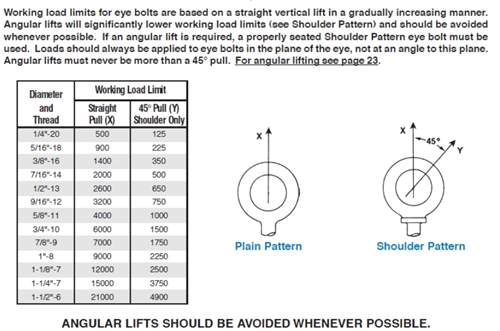
The term for this is called rated capacity. An eye bolt’s rated capacity describes how heavy of a load a single eye bolt can support when the load is angled at 0 degrees. Here is a list of forged eye bolts and the corresponding weight capacity in pounds for typical applications:
Ready to get started? Request a quote.
When choosing an eye bolt it is important to consider the weight, load type, and lift angle of the rope assembly. It is also important to consider the material, size, thread type, and the degree of corrosion resistance, of the eye bolt.
Ready to get started? Request a quote.
Forged eye bolts are made by hammering or pressing a solid piece of metal into a desired shape, while formed-and-bent eye bolts are created by bending and shaping a piece of metal into a loop. Forged eye bolts are typically stronger and more durable than formed-and-bent eye bolts. The choice between the two types of eye bolts depends on the specific application and the required load capacity.
Ready to get started? Request a quote.
There are several common types of eye bolts. A few of these eye bolt types include regular pattern eye bolt, shoulder pattern eye bolt, machinery eye bolt, screw eye bolt, nut eye bolt, and lag eye bolt.
Ready to get started? Request a quote.
Both hot-dip galvanized steel and stainless steel eye bolts can be used in outdoor applications. However, stainless steel eye bolts will endure longer in marine applications and are considered to be more aesthetically pleasing when used in architectural applications.
Ready to get started? Request a quote.
A lag eye bolt is used for threading into wood.
Ready to get started? Request a quote.
A shoulder eye bolt should be used in applications where the load is pulled toward the eye.
Ready to get started? Request a quote.
A regular eye bolt, also known as a plain pattern eye bolt, should be used in applications where the load is pulled away from the eye.
Ready to get started? Request a quote.
Yes, bungee cord is synonymous with shock cord.
Ready to get started? Request a quote.
Bungee balls are secured via a crimped fitting such as a collar, sleeve, c-ring, or knot. They can be applied to the bungee with varying degrees of pressure in order to best suit stretch needs during application.
Ready to get started? Request a quote.
Bungee balls are useful for numerous types of bungee assemblies as they eliminate the rubbing and fraying caused when the bungee cord contacts a surface in the field. In some applications, bungee balls can also be useful as a point of grip or as an alternative end fitting to a hook such as in tarp holding applications.
Ready to get started? Request a quote.
Bungee cord strength is tested by percent of expansion. The maximum recommended expansion during application is 50% of the bungee cord’s resting length. When a bungee assembly is stretched beyond this 50% stretch working limit, the decrease in bungee diameter affects the limit of the bungee fittings holding capacity.
Ready to get started? Request a quote.
Polypropylene is a general-purpose bungee cord that endures well in the outdoors. Nylon bungee cords are ideal in marine applications; however, nylon bungee cord breaks faster than polypropylene in direct sunlight.
Ready to get started? Request a quote.
Lexco Cable, the DBA (Doing Business As) name for K.N.M. Industries, can be found in the Defense Logistics Agency (DLA) Commercial and Government Entity (CAGE) portal using the CAGE Code: 1VXG5.
Ready to get started? Request a quote.
“Domestic” wire rope is stranded and closed in USA. “US Made and Melt” wire rope is made from raw material heats which are melted in the USA before stranding in USA.
Ready to get started? Request a quote.
The following countries are approved by the Speciality Metals flowdown:
- Australia
- Austria
- Belgium
- Canada
- Czech Republic
- Denmark
- Egypt
- Estonia
- Federal Republic of Germany
- Finland
- France
- Greece
- Israel
- Italy
- Japan
- Latvia
- Luxembourg
- Netherlands
- Norway
- Poland
- Portugal
- Slovenia
- Spain
- Sweden
- Switzerland
- Turkey
- United Kingdom of Great Britain and Northern Ireland
Ready to get started? Request a quote.
Felco’s CP is indispensable for cutting steel strapping and banding. They are also especially well-suited to cut string, twine, rope, tin, and many other materials with ease. The red plastic-coated handle is fitted to the hand to make cutting comfortable while a thumb catch locks the cutter when not in use.
Ready to get started? Request a quote.
Felco’s C-108 and C-112 are ideal for marine applications. They are especially suited for the quick and easy cutting of shrouds, stays, halyards, and other rigging of high-tensile wire rope or cable up to a 5/16” diameter. These tools can provide an inexpensive peace-of-mind for the rare time occasion when a mast breaks. Additionally, Felco’s C-9 works well underwater as they are protected against rust and saltwater.
Ready to get started? Request a quote.
Zinc plated wire stops, swivel assemblies, and wire clamps are ideal for very light loads and temporary wire holding applications.
Ready to get started? Request a quote.
Bolt snaps and snap hooks have a wide variety of uses. Light-duty snaps and hooks make excellent key chains and dog leashes. Heavy-duty snaps and hooks can hoist loads as part of a crane operation or can be used to tow boats in marine applications.
Ready to get started? Request a quote.
Stainless steel is the most corrosion-resistant material and also has some of the best aesthetics. Bronze is also corrosion-resistant, and because it is cheaper than stainless steel, you can get a heavier duty bronze snap hook for the same price. Rustproof metal, malleable iron, and steel wire are also cost-effective and widely used.
Ready to get started? Request a quote.
Bolt snaps and snap hooks are made from stainless steel, rustproof metal, malleable iron, solid bronze, or steel wire.
Ready to get started? Request a quote.
Automotive Manufacturing
Nearly 85 million motor vehicles were produced worldwide in 2022 – and wire rope was used in all of them. Automotive cable is used for several purposes in factories and workshops, making parts and assembling vehicles. This includes lifting and carrying parts from one part of the shop to another or between presses on a work line.
It’s also used for hoisting particular pieces, most notably in-process engines, and holding them in place.
Vehicle Control
Inside cars and other vehicles, automotive cable is used for several purposes, with the cable itself being highly specialized depending on use. These include push-pull custom assemblies such as pull-only throttle cables, pull-only clutch cables, gear shifters, and manual transmission systems.
Parking Brake Cable
Automotive cable is used for pull-only brake cables and locking brake levers, with the cable’s tensile strength needing to be finely tuned to act instantaneously with a driver’s touch.
Accelerator Cables
In a vehicle, the accelerator cable – also referred to as a throttle cable – is a wire rope that connects the gas pedal with the engine plate. When pressure is applied to the pedal and released, the driver is able to control the speed of the car. When these cables snap, stretch, or weaken, delayed acceleration or other problems in cruise control may follow. That is why these cables need to be durable, as they control a critical function within the automobile.
Door Latch Cables
When opening the door to a vehicle, there are two release handles at work. One is inside the car, while the other is outside. They’re connected to the door latch cable, especially on large automobiles or doors with more space between the handle and the latch itself. When someone pulls the handle, the cable is pulled as well, releasing the latch. A door latch cable in an automobile will usually include retainers on both ends as well. When these cables corrode, it can become difficult – or even impossible – to open up the door again.
Seat Lock Cable Assemblies
Seat lock cable assemblies in a car are used to lock and unlock a car’s seating arrangement as it is provided on the frame of the vehicle. Strength and durability are key features in this type of automotive cable, as they’ll need to be able to withstand substantial loads.
Other Applications of Automotive Cable
Wire rope and automotive cables have many uses inside of a vehicle, including:
- Seat belt cables – A seat belt pre-tensioner needs a curved cable guide and a flexible cable alike, usually with fitted ends.
- Shift cable – The shift cable, as found on a vehicle with automatic transmission, stands to connect the shifter in the vehicle with the transmission. When motion travels through the transmission shift cable, the transmission linkage moves the shift arm.
- Hood latch cable – Also called the ‘hood release cable’- this is the wire rope that allows you to open up the hood of your car. It typically runs from the handle to the latch under the hood.
- Heater control cables – The part that links a car’s heater to the dashboard, a heater control cable helps the user control the temperature in the vehicle.
Ready to get started? Request a quote.
For all major components, we use Type 316 stainless steel, which is a low-carbon “18-8” chromium-nickel stainless steel modified by the addition of molybdenum that significantly increases its corrosion resistance. T304 stainless steel cable can also be used indoors or in mild environments.
Ready to get started? Request a quote.
End attachments are the designer’s personal choice, as there are a variety of ways to accomplish the same results with different fittings. End posts and aesthetics are the most important factors in determining which end attachments to use.
Ready to get started? Request a quote.
No. A true 90º corner will tweak the cable no matter what construction of cable is used. The physics of the cable does not allow the tension to be equally transmitted from one side of a corner to the other side. Tension must be maintained throughout the entire cable run to meet code, and end fittings should be used to make the corner transition and keep the cable tension in a straight line.
Ready to get started? Request a quote.
Lexco Cable recommends 350 lbs. of tension on each cable assembly for a cable railing.
Ready to get started? Request a quote.
Yes. Cable works great for railing, but only if you have the ability to tighten, and if necessary, re-tighten it with a turnbuckle or with a through-bolted threaded terminal.
Ready to get started? Request a quote.
3/16” cable is the most popular size and useful for railing applications. In high traffic applications such as airports, stadiums, or amusement parks, 1/4” cable is highly recommended. For residential applications where view and unobtrusiveness are paramount, 1/8” cable works well.
Ready to get started? Request a quote.
Generally, 1×19 cables should be used for all railing applications as it is stiff with minimal stretch and ideal for railings with runs up to 50 feet. 7×7 cable is more flexible with additional stretch and can be used for railings with shorter runs, while 7×19 cable is the most flexible but will kink if tensioned on a 90-degree corner.
Ready to get started? Request a quote.
Mechanical fittings are attached when a fitting compresses the cable with a cone inside the fitting or cable. Mechanical fittings are assembled to the cable with simple hand tools, are larger in diameter than swage and hand crimp fittings, and can be reused with a new cone at a certain expense.
Ready to get started? Request a quote.
Hand crimp fittings are attached to the cable with a hand crimp tool. Hand crimp fittings should not be confused with a Nicopress fitting as Nicopress fittings have sleeves made from a soft copper alloy and compress very easily. All hand crimp fittings are made from stainless steel and cannot be swaged, welded, glued, pressed in a vise or with vice grips, or attached to the cable by any means other than specialized tools.
Ready to get started? Request a quote.
A machine swaged fitting is attached to the cable by a swage machine that cold forms the fitting directly to the cable. A swaged fitting should not be confused with hand crimp fittings, or other hand tool applied fittings. A specialized swaging machine is the only way to attach swage fittings to cable as they can not be hand-crimped, welded, glued, hammered, or attached to a cable by any other means.
Ready to get started? Request a quote.
A turnbuckle is a metal coupling device consisting of right and left-hand threaded members screwed into an internally threaded body, which, when rotated, expands or contracts. To see examples of turnbuckles, visit our Gallery.
Ready to get started? Request a quote.
Type 316 has a higher corrosion resistance ranking than type 302/304, while type 302/304 has a higher strength and fatigue resistance ranking. As the carbon content of the stainless steel alloy increases, strength and fatigue resistance also increase, but corrosion resistance is reduced.
Ready to get started? Request a quote.
Stainless Steel aircraft cable is the highest quality aircraft cable available and consists of corrosion-resistant steel wires. While it tests at almost the same pulling strength as galvanized aircraft cable, it lasts longer under harsh conditions in caustic and acidic environments such as saltwater. In mild environments, Galvanized aircraft cable is an economical alternative to stainless steel.
Ready to get started? Request a quote.
1×7
Ready to get started? Request a quote.
19×7 rotation resistant.
Ready to get started? Request a quote.
- 7×7 bare
- 7×7 jacketed
- 7×19 bare
- 7×19 jacketed
Ready to get started? Request a quote.
On a wire rope, nylon coating provides resistance to abrasion, impact, and moisture. Nylon is known for its high temperature ratings and uses in military applications.
Ready to get started? Request a quote.
Coated aircraft cable refers to wire rope that has been given an outer coating of material. This coating provides protection, insulation, strength, and color coding.
Ready to get started? Request a quote.
Aircraft cables are usually coated with PVC, nylon, or HDPE. These coatings have their own uses in individual settings and applications.
Ready to get started? Request a quote.
Only aircraft cables have wire strand cores (WSC) and are available in smaller diameters than wire rope. For example, aircraft cables are available in 3/64” diameter while most wire ropes begin at a 1/4″ diameter.
Ready to get started? Request a quote.