




WE FOCUS ON YOU
Explore Lexco Cable’s video library to learn more about our wire rope products, cable assembly hardware, fabrication services, testing capabilities, and manufacturing processes.
Watch product explainers, see our equipment and manufacturing processes in action, and learn how services such as hydraulic crimping, fuse cutting, mechanical cutting, extrusion coating, marking, and pull testing support custom cable and wire rope assemblies.
You can also learn more about the Lexco Cable team, facilities, quality standards, and approach to customer service.
Get to know the people, facilities, and manufacturing expertise behind Lexco Cable. Explore our team, our approach to customer service, and what makes us a trusted partner for wire rope assemblies.
About This Video
This video introduces the Lexco Cable team’s customer-focused approach and explains what drives its customer satisfaction. Team members discuss maintaining low return rates, responding quickly to unusual or difficult requirements, providing quotes promptly, meeting ship dates and quality standards, and balancing price, quality, and delivery. The video also highlights Lexco’s family-owned culture, hands-on involvement, close teamwork, and long-term customer relationships. Overall, it presents Lexco as a responsive cable and wire rope partner focused on understanding customer requirements, delivering reliable products, and building lasting relationships.
Explore More Videos in This Category
Inside Lexco Cable
An Inside Look at the Lexco Cable Family
Lexco Cable Manufacturers of Wire Rope Assemblies
Explore Lexco Cable’s wire rope products and cable assembly hardware, including threaded studs, plugs, thimbles, shackles, hooks, and turnbuckles. Learn about the components used to configure cable and wire rope assemblies for a variety of applications.
About This Video
Discover threaded studs and plugs used in cable and wire rope assemblies. This video introduces these hardware components and explains their relevance when selecting fittings for an assembly. Explore the product details to better understand the hardware available from Lexco Cable.
Explore More Videos in This Category
Yokes & Clevises
Cable Railing Turnbuckles
Rigging Turnbuckles
Different Shackle Styles
Lexco Cable’s Wire Rope Thimbles
Lexco Cable’s Eye Bolts
Lexco Cable’s Wire Rope Accessories: Eye Hooks, Metal S Hooks & Turnbuckle Assemblies
Lexco Product Display: C-9
Lexco Product Display: C-7
Lexco Product Display: P-22-012
Lexco Product Display: HS-1000
Lexco Product Display: 1-3-SBHS
Lexco Product Display: 1SC
Lexco Product Display: 1BSC
Lexco Product Display: 53-215 Hand Crimp
Explore Lexco Cable’s cable assembly manufacturing capabilities, from hydraulic crimping and wire rope fitting installation to cutting, grinding, coating, and marking. See how specialized equipment and manufacturing processes support custom cable and wire rope assembly production.
About This Video
See Lexco Cable’s custom hydraulic crimping process for wire rope fittings. Hydraulic equipment is used in cable assembly manufacturing to join fittings and cable components securely. Lexco offers a range of crimping and swaging capabilities to support different fitting and assembly requirements. Explore how specialized equipment contributes to the production of custom cable and wire rope assemblies.
Explore More Videos in This Category
Lexco Cable – Fuse-Cutting Aircraft Cable
Lexco Cable – Grinding Cable Ends Flush
Lexco Cable – Mechanical Cutting
Lexco Cable – Zinc Die-Casted Cable End Fittings
Lexco Cable – Extrusion Coating of Aircraft Cable & Wire Rope
Lexco Cable – Laser Marking
Lexco Cable – Pull Testing
Laser Marking from Lexco Cable
Explore how Lexco Cable evaluates cable assemblies and fittings through pull testing and proof-loading. These tests help assess assembly strength, verify performance against specified requirements, and document results.
About This Video
This video features a destructive pull test of a custom threaded-stud wire rope assembly. Lexco used a calibrated pull-test machine to apply load and observe the assembly’s performance, documenting the test with photos, video, and a test certificate. The related case study describes a target pull-off strength exceeding 35,000 pounds for this specific application. Test requirements and results vary by assembly and application.
View Additional Pull-Testing Video
Additional Pull-Testing Video
Inside Lexco Cable
Why Work with Lexco Cable Team
About This Video
This video introduces the Lexco Cable team’s customer-focused approach and explains what drives its customer satisfaction. Team members discuss maintaining low return rates, responding quickly to unusual or difficult requirements, providing quotes promptly, meeting ship dates and quality standards, and balancing price, quality, and delivery. The video also highlights Lexco’s family-owned culture, hands-on involvement, close teamwork, and long-term customer relationships. Overall, it presents Lexco as a responsive cable and wire rope partner focused on understanding customer requirements, delivering reliable products, and building lasting partnerships.
View Video Transcript +
Customer satisfaction means we’re doing a good job—the service that they need and the product that they want. So it means we’re doing something right.
Customer satisfaction means several things. One is that we have a very low return rate; actually, it’s sort of non-existent. A lot of customers come to Lexco because we’re able to accommodate their needs, regardless of their requirements.
But on occasion, the customer will need something that’s a little bit unusual or a little bit harder to get. We explore all the avenues we can, as quickly as we can, to get the quotes for the things that they want, and we try to get those quotes to them within a day. Hopefully, we’re being successful at that most of the time.
Lexco goes above and beyond for their customers by doing as much as physically possible to meet ship dates and quality standards that they go by.
I think because Lexco Cable is in the Chicagoland area, we’re centrally located. We can get product out quickly to both coasts.
Well, they keep coming back to Lexco because we have a unique blend of pricing, quality, and delivery that suits their needs.
Everybody in a family-owned company seems more together. People care not only about each other but the product because it’s highly personal to the family. We’re very hands-on. We partner with our customers to build long-term relationships, and they keep coming back for that reason.
We give them above and beyond what they expect. We stand behind our products, no matter whats happens we gonna be there.
Now that you’ve met a few members of the Lexco Cable team and you’ve seen several of our processes, you can see for yourself that we work very closely together, and every department is invested.
We grow with our customers. We partner with our customers, and we grow together. And that’s our strategy.
Thank you for visiting Lexco Cable.
An Inside Look of what it's Like to be Part of the Lexco Cable Family
Lexco Cable Manufacturers of wire rope assemblies lexcocabledev.wpenginepowered.com
About This Video
This video provides an inside look at Lexco Cable’s wire rope assembly manufacturing and its approach to producing custom cable solutions. It covers the company’s history, custom assembly capabilities, automatic cutting equipment, extrusion, production planning, and quality-control processes. Lexco explains how assemblies are produced for different industries and quantities, with attention to dimensions, material, cable construction, flexibility, bend radius, and inner diameter. The video emphasizes Lexco’s ability to develop solutions around customer requirements, manufacture to specification, and deliver complete assemblies within demanding lead times.
View Video Transcript +
Let’s go assemble a solution—both literally, cable assembly solutions, and also distribution solutions of wire rope products, and also the emphasis on providing a solution to the customer.
We’re like the short-order cook of the cable business. We get an order in, customize cable, and within a few weeks it’s out the door, complete. And it could be 10 pieces up to 30,000 pieces.
You can consider them an OEM, an original equipment manufacturer. This was a ground-up operation.
Well, the company started in 1952 when I came back from Korea, in a little store on the West Side. Harold was able to take a piece of straight cable and invent a way to coil it and take the ends of the cable and swage it, and we came out with the cable. And it went over pretty well.
Our main core business at Lexco is providing assembly solutions to the customer. So when customers need new and different operations and new and different assemblies, we look for the technical abilities to support those.
We have automatic cutting equipment. The extruder is making this whole business—all the different cables that you see here are from the extruding
Here at Lexco, we produce a wide variety of custom cable assemblies, and our challenge really is to get to the wide variety of industries that need cable assemblies.
The cable is going to be used for something. It has a purpose and a function. As partners with our customers, we’re all about providing the cable that’s best for them, and we’ll provide the best solution for them.
Then, after production, we do a lot of random sampling to quality-check all of the dimensions and material, diameters, construction, flexibility, bend radiuses, and inner diameter. That way, when we ship it, we ship it correctly the first time.
Our production manager will look at those orders, prioritize them, prioritize the skills that we have in our production people, and assign different people to different stations to work on the orders of the day.
I’ll tell you why you want to work with me: because I’m going to deliver the product how you need it, when you need it, and possibly cheaper than the other guy.
We deliver what we promise, when we promise.
Lexco Cable - Custom Hydraulic Crimping Wire Rope Fittings
Lexco Cable - Fuse-Cutting Aircraft Cable
Lexco Cable - Grinding Cable Ends Flush
Lexco Cable - Mechanical Cutting
Lexco Cable - Zinc Die-Casted Cable End Fittings
Lexco Cable - Extrusion Coating of Aircraft Cable & Wire Rope
Lexco Cable - Laser Marking
Lexco Cable - Pull Testing
Laser Marking from Lexco Cable
Yokes & Clevises
Cable Railing Turnbuckles
About This Video
This video explains the different turnbuckles and adjustable fittings used in cable railing applications, with separate examples for wood and metal posts. It covers deck toggle and hanger-bolt configurations, threaded terminals, receivers, terminator and button turnbuckles, jaw turnbuckles, and smooth-line options with internally swaged fittings. The discussion also addresses staircase installations, ball-ended and articulating fittings, and applications in marine, architectural, and industrial rigging. The video demonstrates how fitting design, mounting method, adjustment mechanism, and post configuration affect the selection of a cable railing or rigging turnbuckle.
View Video Transcript +
Introduction
Hi, I’m David Carbon, Vice President of Lexco Cable. Today’s topic is cable railing turnbuckles.
We’re going to break that into two categories. One is what kind of cable railing turnbuckles might you use with a wood post, and then second, we’ll tackle what kind of cable railing turnbuckles might you use with a metal post.
Let’s begin with the wood-post option.
Wood-Post Turnbuckles
We’re going to look at the wood-post cable railing turnbuckles first.
I want to show you a couple of versions. In the middle is a deck toggle turnbuckle, and at this end is the deck toggle. It has two wood screws mounting it to your wood post. And because it’s mounting here on the base of the post, you can consider this a surface-mounting turnbuckle.
So this surface is your bearing point.
What’s great about a surface-mount turnbuckle is that you may have another railing that is on the opposite side of your post. By using a surface mount, it helps you avoid the intersection that would be an undesired intersection of fasteners in the post, both trying to terminate in the same spot.
So the face-to-face, surface-to-surface arrangement is clean.
This is the deck toggle turnbuckle, and it is being represented with wood screws.
The next two turnbuckles I’m going to show you are the same concept executed two ways.
I saved the same concept because there is a hanger bolt. A hanger bolt means that it has machine threads on one side, and on the opposite side it has lag, meaning wood-screw threads.
In this top example, this is called an adjustable-width hanger bolt. Here you can just see, in between the body and the wood, you’ll see the machine threads. And then what you don’t see is inside the post. That is where the lag wood-screw threads are on that hanger bolt.
This turnbuckle is very compact and sleek. The secret is the ferrule inside this body.
The cable is being terminated to a ferrule, and that ferrule is sitting just on the inside here. That ferrule is a short barrel and is machine-swaged with a hydraulic swager. It hides right inside here.
And then there is a wrench flat here, and that allows you to adjust the body on the hanger bolt.
The second variation of a hanger bolt on a turnbuckle is down here at the bottom.
And this variation is a classic. It’s a classic in the sense that it was born from sailboat lifeline turnbuckle assemblies.
You have here a threaded terminal. So this threaded terminal is what the cable is terminating into. Then you have machine threads, and then you have a turnbuckle body. And then you have the hanger bolt that I mentioned here.
Here you have the machine thread, and then inside the post are the lag wood-screw threads.
So that is an overview of the turnbuckles for cable railings if you’ve got wood posts.
Next we’ll go over the other options if your post is not wood.
The display that I have in front of me was made for my showroom, and I had it made out of angle iron. The main reason for that was so that the ends of the turnbuckles could be observed in a real-life cable railing installation.
You’re most likely going to use a tube or a post, and the post could be square, could be round, and then some cable railings using metal posts might use flat bar.
So just keep that in mind as you’re observing the fitting and how it might interact with your particular end-post choice.
Metal-Post Turnbuckles
In this video, we’re talking about cable railing turnbuckles. And by turnbuckle, I mean that it is an adjustable fitting.
So I’m going to show you a threaded terminal. A threaded terminal is not quite a full-on turnbuckle, but it’s adjustable.
Let’s start there.
Down here you’ll see this threaded terminal is being fastened at the end with simply a jam nut and then an acorn nut.
That is the most simple variety that you’re going to get in an adjustable cable railing fitting.
So the next version, which I would say is like a second generation of a threaded terminal for the end termination, is instead of using a jam nut and acorn nut, it uses a receiver.
Here’s an example of that. At the top you can see you’ve got your threaded terminal, and it’s not going into a nut; it’s going into a receiver.
So the receiver is tapped. It’s got internal threads, and the receiver head has an Allen-head slot so that you can use an Allen wrench and turn your receiver. And that takes up your turnbuckle.
So if you don’t want an acorn nut, this is more elegant.
Now, there is such a thing as a version of the receiver where you do not have to see as much threaded terminal. And an example of that is down here.
Now, the way that’s pulled off is that inside this receiver is a small threaded stud called an “invisible,” and it’s been machine-swaged. So it’s been hydraulically swaged. That allows it to fit within a very small envelope, but it’s the same concept where you’ve got a stud mating with a receiver to provide your assembly take-up.
So I’m going to move on to this terminator turnbuckle.
In this example, the body has been swaged directly to the cable. And here, this is a bolt. So you would turn the bolt like you do a receiver head with an Allen wrench, and that provides take-up as well.
So it’s a close cousin to the receiver that we spoke about.
Next, I’ll show you a button turnbuckle.
Here is a Smooth-Line button turnbuckle. Here is a Deco button turnbuckle.
In these turnbuckles, you’ve got a threaded terminal, and then here you’ve got a threaded rod, and then at the end you’ve got a button at the bearing point.
Now, in this version it does look different, and that’s because this is a Smooth-Line. In the Smooth-Line, there is not a threaded terminal on this point. Instead, you have an internal ferrule that is swaged to provide a more aesthetically minimalistic look.
Another example of a turnbuckle is a jaw turnbuckle.
Here’s a classic jaw turnbuckle. In this classic jaw turnbuckle, you’ve got a threaded terminal, turnbuckle body, and then you have a threaded rod. The threaded rod has a T at the end. That T provides a bearing point for this clevis that makes up the jaw, and the jaw has a clevis pin.
So a common way to attach a jaw to your post is with a tab. So think of this piece of the angle iron as a tab.
There is another type of jaw turnbuckle. For example, you could get it in a Smooth-Line, the Smooth-Line being the version with the fittings swaged inside.
And then the other version of a Smooth-Line jaw turnbuckle is an adjustable jaw turnbuckle.
On the other side of this display, you will find the adjustable jaw turnbuckle. Here’s the adjustable jaw turnbuckle.
Inside, you have a barrel that has been machine-swaged, you’ve got machine thread, and then you’ve got a jaw.
So that is an overview of most of the cable railing turnbuckles that you would find with metal posts for your cable railing application.
Stairs
Obviously, cable railings are popular for staircases.
On staircases, you’ve got the slope of the staircase. So to tackle that angle, you may need to consider your turnbuckle.
The top examples on this display utilize a ball at the end.
Here you’ve got a Deco turnbuckle with a ball, classic turnbuckle with ball, Smooth-Line turnbuckle with ball, and here you have a threaded terminal with ball.
At the bottom of the display is the deck toggle, and this deck toggle is being demonstrated with machine thread. So you would need to tap your metal post so that you could use metal fasteners to mount your deck toggle.
One question is: Can you use these turnbuckles from a staircase also on a level run?
And the answer is, hell yes, you can.
This ball works just as good on level runs as it does on the staircase.
Same thing with this deck toggle. It will articulate to a level position, and that is an example of some staircase turnbuckles.
Rigging
While we’re on the subject of cable railing turnbuckles, I also want to mention that they can be used in rigging applications, such as marine rigging.
In marine rigging applications, you may need a larger diameter than you would in a cable railing.
So here’s an example of a jaw turnbuckle for a rigging application. It’s just like a cable railing version, only larger, and this will hold to the cable break strength on the rigging model.
Now here you’ve got the threaded terminal that will be swaged to the cable.
If you do need a marine turnbuckle, you may need a jaw-to-jaw turnbuckle, and you can also find that on our website.
This is a toggle jaw. It can toggle to the sides.
This is a toggle jaw marine turnbuckle.
We also do all kinds of rigging projects that are industrial or architectural in nature. It could be a trellis; it could be cross-bracing.
So we are able to provide all kinds of heavy-duty turnbuckles.
In this example, I’ve got a threaded terminal and then I’ve got a jaw, and this is actually an open body.
So we do all kinds of custom cable railing architectural turnbuckle applications.
Rigging Turnbuckles
Different Shackle Styles
Threaded Studs and Plugs: What You Need to Know
About This Video
This video explains Lexco’s threaded plugs and threaded studs, including how their sizes, thread configurations, cable diameters, and designs can be matched to different applications. Examples cover light-duty threaded plugs, longer thread lengths, coarse and fine threads, lifeline tapers, custom architectural assemblies, and large or specialty studs. The video also discusses mil-spec components for aerospace and defense applications and explains Lexco’s machine-swaging process using controlled tooling and hydraulic presses. It concludes by showing installed assemblies and encouraging customers, engineers, and buyers to provide cable, thread, and length requirements for custom quoting.
View Video Transcript +
Hey, I’m recording a video to tell you about one of our wire rope product lines. We call it threaded plugs and threaded studs.
The threaded plugs are really just smaller threaded studs. They’re a little bit smaller in diameter and thread size. They’re typically going on a smaller wire rope diameter.
So let me get right into it. I want to show you some examples of fittings loose, and then I’ll show you some examples of those same fittings swaged onto the wire rope.
First off, in the threaded plugs, let’s start off with a quarter-inch diameter fitting.
This is a 1/4-inch threaded plug, and it’s got a 1/4-20 thread. This model will go on 1/8-inch wire rope.
The 1/4-inch size could also be used on 3/32-inch cable. We would just drill a different cable ID.
One thing you’ll hear me talking about, for example, is that a 1/4-inch threaded plug could also be about the length of a quarter. This model was for a light-duty application where just a small amount of holding strength was needed, and only a small amount of thread length was needed because it was bottoming out in a tapped hole.
Let’s step up in size, both in terms of thread size and wire rope diameter size.
That brings us to 5/16-inch.
This is a 5/16-inch threaded plug. It’s going to be difficult to see, but this one has a yellow zinc plating finish. Most of the time, the carbon-steel model will have a clear zinc-plated finish.
And this model for 5/16-inch thread could either be installed on 3/32-inch or 1/8-inch cable—your choice—but you have to let us know so we can provide the right blind-hole ID.
Here’s a 5/16-inch threaded plug. You’ll see it’s a much longer in the thread length. This was for a 2.8-inch thread-length requirement and only about one inch of area here, with maybe a 5/8-inch blind hole. And this one will also go on 1/8-inch cable diameter, a very, very common cable diameter.
Those are threaded plugs.
They’re usually used on small-diameter wire rope, also known as aircraft cable, typically starting around 1/32-inch cable diameter.
Then, once you get up to about 1/4-inch cable diameter, you probably have a higher holding-strength requirement, and you’re going to want to step up the threaded plug in holding strength, too.
That’s why it would make sense to start to browse the threaded stud category.
Now, sometimes, though, you do have applications where you don’t need full holding strength.
So this particular example is a threaded plug with a 3/8-inch thread diameter, and the customer wanted it installed on a 1/4-inch cable.
This was for an architectural application where the assembly needed to be taut, but the fitting did not need to hold all the way to break strength.
This was custom for a special architectural feature. Actually, it was for a vertical cable railing façade on a building in California.
Yeah, what I was just holding up was coarse thread and UNC thread.
We also do threaded studs and fine thread.
Here’s two examples. Let’s take them one at a time.
This one has a cotter hole, and once in a while there’ll be an application where you want to put a cotter pin or seizing wire at the end to prevent the fastener from shaking loose, usually because it is a very dynamic load. It could be a lot of vibration. It could be critical safety. It could be a feature that might come up.
And in this fine-thread stud, it has a wrench flat like the one we talked about, but it has one other feature: it has a taper.
And that taper is sometimes referred to as a lifeline taper.
Why do we do that? Because a lifeline threaded stud was originally used for a lifeline cable on a sailboat cable railing. It prevents you from falling over, also known as a lifeline.
And this model has a taper, so it’s going to be a smooth transition from the stock diameter down to the thread major.
And this is very popular for cable railings to have that taper. That’s what we mean by a lifeline thread.
So let’s show you just a couple more examples of threaded studs before we move to the assemblies.
Here’s a Predator stud with 6 inches of thread length, 12 inches of overall length, per customer specification. They wanted that feature to mimic a tie rod, but they needed more flexibility, and that’s where the wire rope came in handy for improved performance.
One last threaded stud is this mammoth one. It’s a 1-1/4-inch stock diameter turned down to a 1-inch fine thread, and it was installed on a 1/2-inch wire rope.
One product line in this category is mil-spec MS-21259 and MS-21260.
These are typically used for aerospace and defense applications where that kind of critical application is paramount, maybe a mission-critical assembly.
And they have a wrench flat and inspection hole, and they’re made to a specific standard, manufacturer, and QPL source.
These threaded plugs and threaded studs are installed at the end of the cable, the wire rope. They’re designed to be machine-swaged.
That means that we use tool and die on hydraulic presses in our shop, in a controlled environment with quality controls, to swage it to the wire rope to get optimal performance and consistency.
And that’s what we specialize in: assembly fabrication.
This model I showed you uninstalled, and you’ll see that it is elongated. That is from the compression from the swaging process.
And by swaging, I just mean machine crimping with tool and die.
This example was swaged onto a 1×19 stainless steel strand for an architectural application.
Here’s that 1/2-inch wire rope assembly, and you can really see where it was compressed down to meet the holding strength of that 1/2-inch wire rope.
Here’s an example of a mil-spec MS-21259 installed on a 7×19 galvanized aircraft cable. And this, again, was for the mil-spec application.
One example of a threaded stud is a threaded stud that has been hex-swaged.
So we did not install a wrench flat. Instead, we hex-swaged it. It started out as a round stock diameter, and then after compression it left a hex profile, which you can hold with a wrench in order to do torquing of your nuts in the adjustable section.
And this example was on a 1×7 galvanized extra-high-strength strand for a barrier application.
It’s just a general-purpose threaded stud that was installed on 3/8-inch 7×19 galvanized aircraft cable, with extra-long thread length and extra-long overall length.
Here’s an example of the threaded plug.
And in this example, you’ll see it was hex-swaged. Hex swaging is highly common in the threaded plug space.
And this example was made out of a 7/16-inch stock diameter and was hex-swaged to 3/8-inch, and it has a 7/16-inch UNC thread.
And it’s installed on a 3/16-inch 7×19 stainless steel cable.
So those are the examples that I prepared for you today.
And I want to encourage you to contact us, because we really want to hear from you if you’re having trouble with your assembly, if you’re designing a new assembly, if you have an assembly that you just need to have quoted.
If you’re a purchasing buyer or you’re an engineer, please reach out to us. We’re always here, and we love talking wire rope assemblies.
You can contact me at david@lexcocable.com. We’ll leave that for you at the end.
You can call me at 800-626-6556, extension 316.
And we also have prepared a special form for you where you can just go ahead and fill in the critical characteristics you’re looking for, like the wire rope size, the thread size, and the length.
Then we’ll take that information and we’ll email you back with some options and start a dialogue.
And that’s really what we do best: We help our customer who has maybe they know exactly what they want, somewhere between that and knowing vaguely what they want, and then we turn that into a bill of materials that we manufacture to their specification in a very compressed lead time.
That’s where we shine.
Lexco Cable's Wire Rope Thimbles
Lexco Cable's Eye Bolts
Lexco Cable's Wire Rope Accessories: Eye Hooks, Metal S Hooks & Turnbuckle Assemblies
About This Video
This video reviews several wire rope accessory and hook types offered by Lexco, including hoist hooks, swivel-eye hooks, grab hooks, shank hooks, S-hooks, and fall-protection hooks. It explains differences in hook geometry, connection methods, latches, working load considerations, and suitable applications. The video also covers carbon steel, alloy steel, galvanized, painted, and stainless steel options, including choices for corrosive or marine environments. Lexco then demonstrates completed assemblies such as turnbuckle and winch assemblies, trailer safety cables, and coiled cable assemblies, showing how hardware can be combined with wire rope to create application-specific solutions.
View Video Transcript +
Introduction
Hi, I’m David Carbon, Vice President of Lexco Cable, and today I wanted to talk to you about hooks, part of our hardware category of products.
We have a few different product lines that you could loosely call hooks.
I’m going to talk to you about the first one, which is a true wire rope rigging hook.
Rigging Hooks
One thing that these hooks have in common is that they’re all going to be load-rated, and you’ll see on our website there will be working load limits listed.
You can contact us for any strength information regarding the hooks.
Hoist Hooks
Now I want to actually show you some examples.
The most common type of hook that my wire rope customers use would probably be the eye hoist hook.
Here is an example of the eye hoist hook. The eye part being at this point, and that’s a connection point. It’s a solid eye.
The hoist hooks commonly include the latch. It’s possible to get an eye hoist hook where the latch has to be purchased or assembled separately, but most of the time you’ll find that it comes with the latch kit assembled.
Another variation on this hoist hook is with a different eye.
So instead of that solid eye, you can also have a swivel eye.
The swivel eye allows the load that you’re hoisting to rotate, and that can help the wire rope from twisting in some applications.
Where you’re hoisting with a solid eye, it might be necessary to use a rotation-resistant wire rope.
Grab Hooks
One other variation on this kind of hook is a grab hook.
This particular example of a grab hook has a solid eye, but they do come with a clevis in lieu of a solid eye.
What you will notice about the shape is the mouth. The mouth is much more narrow, and it’s a straight channel. It’s meant for hooking onto a smaller stock diameter, and it retains that because of the narrower channel.
Shank Hooks
Another type of hook is a shank hook.
This particular shank hook has threads on the end of the shank hook, where you could thread that into tapped hardware, or you could put it through a plate and bolt the top.
Another type of shank hook, instead of having threads here, it’s blank, and some customers will weld that onto their assembly.
And then there’s a third type of shank hook, and that type is where the shank has had a blind hole drilled for the purpose of accepting the wire rope assembly, such as you see here.
And what’s nice about this assembly is that you don’t have a wire rope loop. You have your wire rope terminating right into your hook.
So if you have a spatial issue where you have clearance issues and the loop is causing a problem, there is a possible solution with a shank hook.
S-Hooks
And then what other type of hook is an S-hook.
There are many different configurations of the S-hook.
For example, you can have S-hooks where the posts are the same length on each end, or in this example you see that there’s a longer post on one side and a shorter post on the other side.
S-hooks come in different thicknesses, obviously, and little nuance differences.
And you could even get this size of an S-hook with a wire latch, as shown here.
Why would you want the S-hook to have a wire latch?
Well, you might have an application where you don’t want the assembly to come off a hook. Because instead of it being a vertical lift assembly, it might be horizontal.
Think of a trailer safety cable.
And the S-hook can help make sure that your assembly stays in place, dealing with environments that have vibration and movement.
Fall-Protection Hook
One last type of hook I wanted to introduce to you in this video is a fall-protection hook.
The thing that fall-protection hooks have in common is the double latch.
The purpose of the double latch is to make sure that your latch doesn’t open when you don’t require it to.
Meaning, you first have to press the safety latch before it will allow the actual latch to free up.
You’ll see this type of hook used in fall-protection applications in tandem with fall-protection harnesses and fall-protection equipment.
Materials
I also wanted to mention some materials that you’ll come across with hooks.
The eye hoist hooks, for example, come in carbon steel and alloy steel.
The alloy has a higher breaking strength.
In terms of finish on the carbon and alloy hooks, you could get a zinc-plated, sometimes called electro-galvanized, finish. You could get hot-dip galvanized, and you could also get a painted finish.
Besides the carbon and alloy options, there’s also stainless steel options available for corrosive environments, such as marine applications.
Hook Assemblies
And the next I want to do is show you some examples of S-hook assemblies, because after all, that’s what we specialize in at Lexco: taking the hardware and adding value to it by fabricating it into an assembly.
The first model I’ll show you is a turnbuckle assembly.
This particular hook is a hoist hook with latch, and in this case it’s attached to something called a hammer link, and that’s going to be attached to a turnbuckle jaw.
Even if the assembly doesn’t involve wire rope, it could be a chain assembly. We can also attach hooks to those kinds of assemblies.
Here’s a very common assembly.
Usually you would see this on a winch drum used for a winch application. It could be a winch on a Jeep, for example, and you need the latching eye hoist hook on a thimble loop.
Coiled Cable Assemblies
Next, I want to show you some coiled cable assemblies.
I mentioned before trailer safety cables, so now I’m going to show you some of those.
The first one I’ll show you has a coiled wire rope, coated wire rope, a strip thimble loop for load-bearing properties, and then on the second loop you’ll see that there is a hook with a latch.
This particular hook with latch is a clevis hook because it’s got the removable clevis pin.
And if you’re noticing that yellow hue on this hook, it’s because it’s got a yellow chromate zinc plating.
On this trailer safety hook assembly, there’s a hook on both ends.
And here you’ll see a painted hoist hook, and this one does not have thimbles in the loops.
Here’s an example where there are thimbles in the loops, but the loops are coated. This is for a lower strength.
And we’ve got an eye hoist hook on one loop.
I showed you S-hooks earlier. Well, here they have an S-hook with a latch attached to the trailer safety cable.
If you have any questions, we’re always here to help you out, and I’ll see you next time.
Thank you.
Lexco Product Display: C-9
About This Video
This short product demonstration features the Felco C-9 cable cutting tool and shows it cutting two common wire rope sizes. The video identifies the tool’s stated maximum applications, then demonstrates the cutter on 3/16-inch 7×7 galvanized aircraft cable and 1/4-inch 7×19 galvanized cable. The demonstration gives viewers a practical example of the C-9 being used on different cable diameters and constructions. It is primarily a concise product-use demonstration rather than a detailed technical explanation, making it useful for customers evaluating a hand-cutting tool for compatible wire rope applications.
View Video Transcript +
Hi, this is a Felco C-9 cutting tool, and it’s used with 5/16-inch 7×19 galvanized maximum.
If you’re doing 1×19, then you would need to do about 1/4-inch 1×19 maximum.
Today I’m going to demonstrate it on two diameters.
The first one is 3/16-inch 7×7 galvanized aircraft cable.
[Demonstration]Okay, that was 3/16-inch.
And then the next size I’ll show you is 1/4-inch 7×19.
[Demonstration]That’s the Felco C-9.
Lexco Product Display: C-7
Lexco Product Display: P-22-012
Lexco Product Display: HS-1000
Lexco Product Display: 1-3-SBHS
Lexco Product Display: 1SC
Lexco Product Display: 1BSC
Lexco Product Display: 53-215 Hand Crimp
5/8
Pull Test On 5/8
LOOKING FOR MORE?
Gain a deeper understanding of everything we have to offer and visit our resources page for case studies, technical assets, configurators, FAQs, and more.
LEXCO® CABLE: YOUR WIRE ROPE ASSEMBLY EXPERTS
For over 50 years, we have served nearly every industry with top-quality wire rope and cable solutions. Whether you’ve been working with wire rope for years, require a highly specialized solution, or are still searching for what you need, we can help.

FAQs
Explore our comprehensive FAQs to learn everything about wire rope, bungee cords, end fittings, and more.

POLICIES
Find Lexco’s most frequently requested policies, including our return policy, minimum order policy, and more.
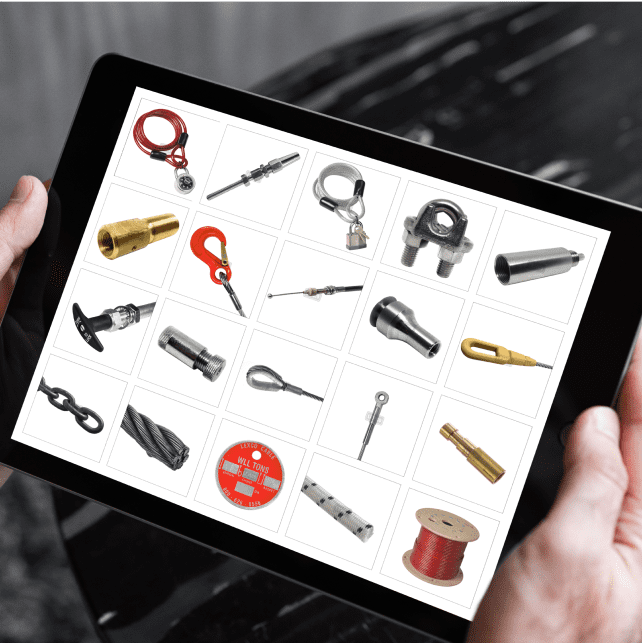
GALLERY
From coiled cables to architectural railings, see examples that showcase our capabilities and inspire your next project.
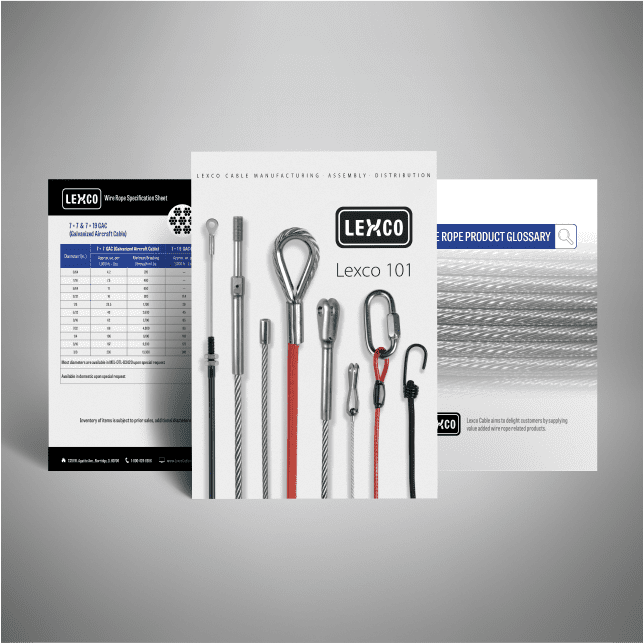
DOWNLOADS
Whether you need detailed information on our wire rope products or specific guidelines, you’ll find it here.