



Custom Cable Assemblies & Wire Rope Fabrication: Solutions for Complex Applications

Custom Cable Assemblies And Wire Rope
Fabrication: Solutions for Complex Applications
Summary
Custom cable assemblies are engineered solutions designed to meet the rigorous demands of unique applications where standard parts fall short. This guide explores:
Key Takeaways
- Custom fabrication is required when off-the-shelf parts cannot meet unique load, clearance, and environmental specifications.
- Material selection, including stainless steel and coatings, is vital for maximizing lifespan and corrosion resistance.
- The correct wire rope construction is essential for balancing flexibility and strength based on application needs.
- Termination methods like swaging or die-casting determine the final strength and production volume capabilities.
- Professional fabrication ensures strict adherence to critical dimensions and tolerances to prevent field failures.
A custom cable assembly is a complete, ready-to-install wire rope or cable product that is manufactured to specific engineering standards. Unlike bulk wire rope, custom wire rope cable assemblies incorporate specific end fittings, specialized fabrication techniques, and precise dimensions that are strictly measured to meet unique application requirements.
These assemblies are not merely raw materials. They are finished components designed to integrate seamlessly into a larger mechanical or structural system immediately upon delivery.
While standard, off-the-shelf parts may seem convenient, they come with inherent limitations that can compromise the integrity of a complex project. Standard parts are mass-produced to general specifications, meaning they often do not account for unique load requirements or the specific stress factors of a given application.
Furthermore, stock components rarely address constraints such as tight clearances within a machine’s housing or the chemical demands of specific corrosive environments. In scenarios involving complex motion control needs, a generic cable simply cannot provide the precision required for safe and repeatable operation.
What Are the Key Types of Custom Cable Assemblies and Wire Rope Fabrication?
Lexco Cable specializes in custom wire rope cable assemblies, providing a solution that bridges the gap between design theory and real-world application. This approach allows for total customization according to customer specifications, ensuring that every aspect of the assembly is optimized for the task at hand.
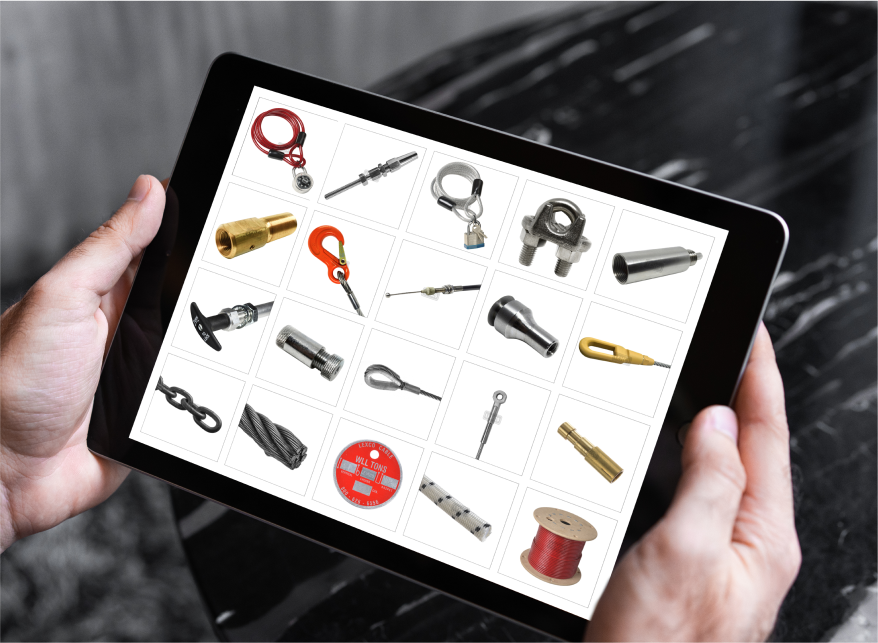
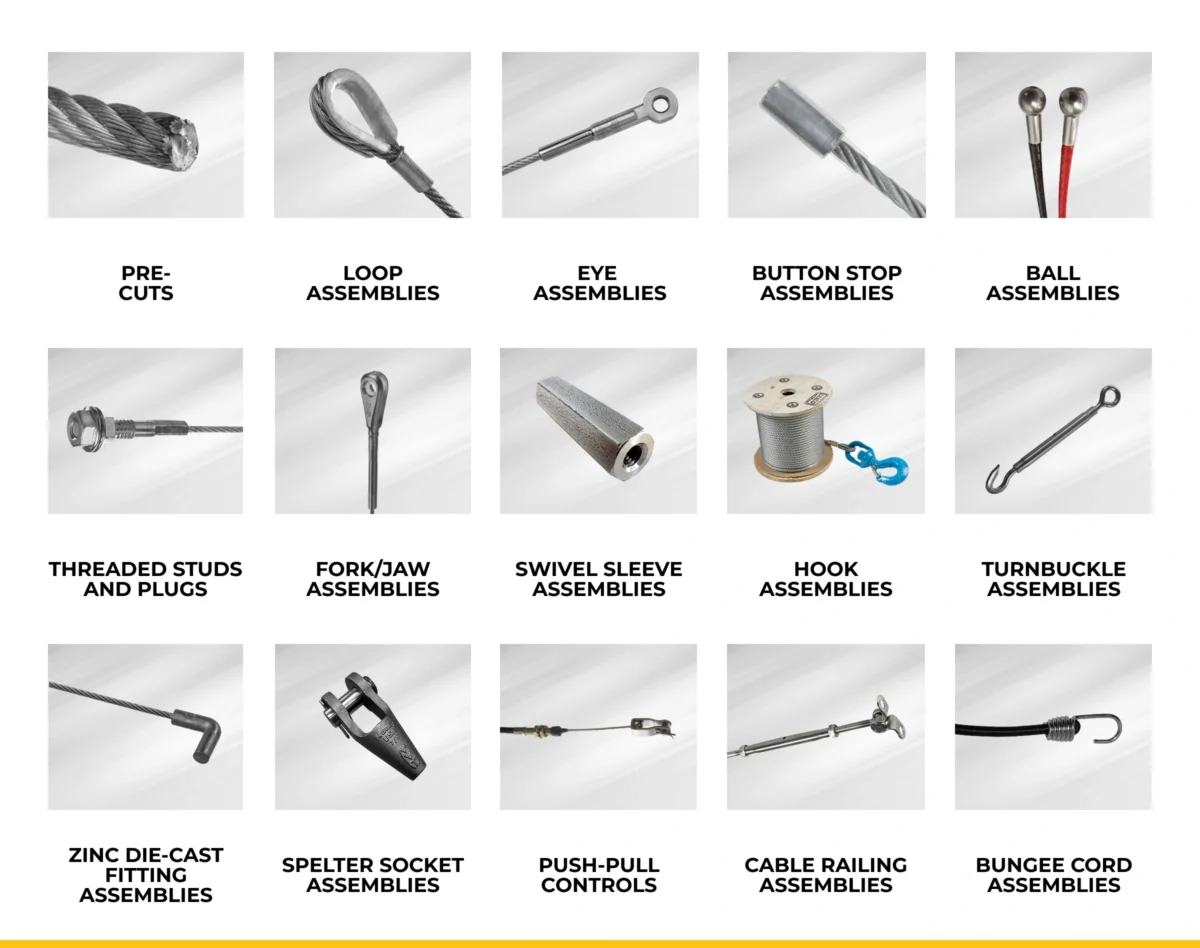
But before choosing a custom cable assembly, it’s important to understand the key types of assemblies and the different components of wire rope fabrication:
Pre-Cuts
Pre-cut lengths of wire rope that can be later fitted with hardware. Fuse-cut ends are popular to avoid fraying. Lexco can kit the pre-cuts with wire rope clips, ideal for field-installed loops.
Loop Assemblies
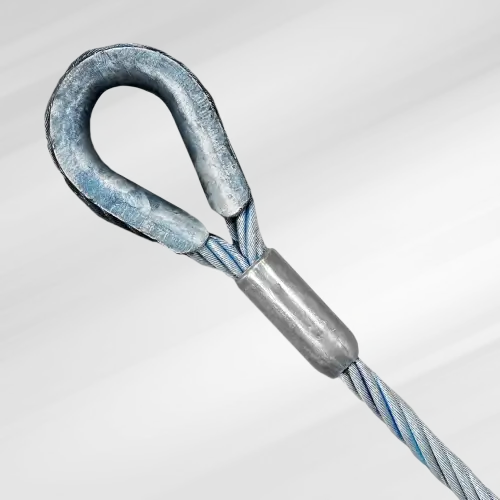
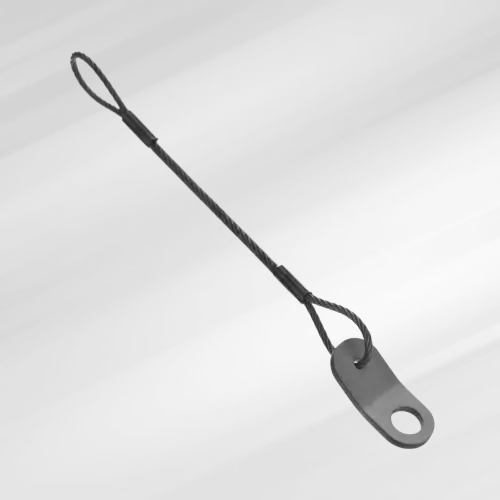
Custom-length wire rope assemblies with ends that are looped back on themselves, swaged or clamped to secure the loop, and sometimes fitted with thimbles to reinforce the inside of the loop. Loop assemblies are useful for applications requiring easy connection of the rope to other hardware and various rigging points.
Eye Assemblies
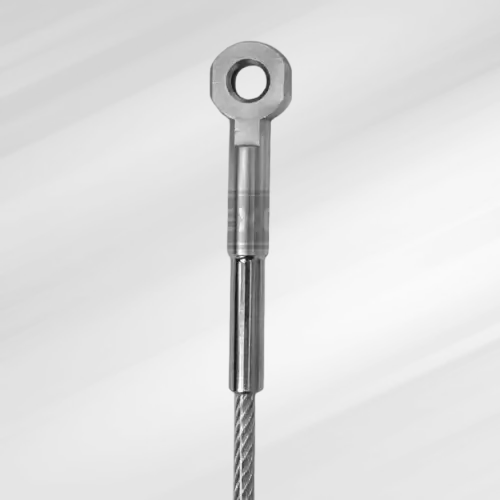
Eye assemblies are wire rope terminations that form a permanent loop for connection to pins, bolts, shackles, or other hardware. Common configurations include stamped eyelets for, strap eyes, marine eyes, and MS20668 eyes. When standard options do not meet dimensional, load, or environmental requirements, custom eyes can be engineered to suit the application.
Button Stop Assemblies
Cylindrical button stops are swaged to a wire rope to act as an anchor or bearing point along the length of the wire rope, usually at the ends. These are common in railings, winch assemblies, and industrial control cable assemblies.
Ball Assemblies
Plain balls, single shank balls, and double shank ball fittings are swaged to the end of a wire rope or cable to act as a spherical stop, a quick-release mechanism, or a method of transferring movement while still allowing a limited range of motion within the corresponding socket. These are common in control systems and other applications that require a secure radiused connection.
Threaded Studs and Plugs
Both threaded studs and plugs are swaged to the ends of wire ropes made for tensioning of the wire rope through the adjustment of mating threaded components. These are common in bracing and railing systems, which require precise tensioning for proper performance of the custom cable assemblies.
Fork/Jaw Assemblies
Wire rope fork/jaw assemblies are swaged to the end of the wire rope to allow for a secure and strong connection using a bolt or pin. These allow for the wire rope to pivot, avoiding flexing and fatigue in the wire rope assembly.
Swivel Sleeve Assemblies
Swivel sleeves free-float on a custom wire rope cable assembly to allow full rotations of the threads without twisting the wire rope.
Hook Assemblies
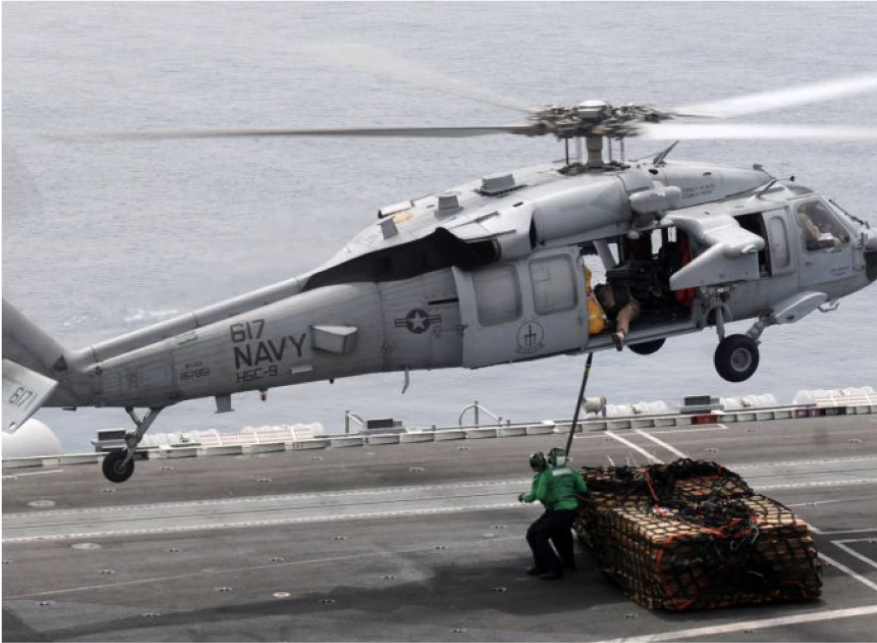
Hooks fitted to the ends of a wire rope, including S-hooks, eye hoist hooks, and other specialty hooks, are used for lifting and towing. The applications depend on the size and strength of the hook, but they all allow for quick connections and high-strength pulling/lifting.
Turnbuckle Assemblies
Turnbuckles are fittings with two opposing threaded bolts facing each other, such that when the fitting is turned, the bolts are pushed further apart or pulled together. These allow for tensioning and adjustment after installation.
Zinc Die-Cast Fitting Assemblies
Zinc die-cast cable fittings are molded into shapes that are not easily swaged, such as barrels, “L”-shape, “Z”-shape, bullets, and radiused buttons. Sometimes eye ends are zinc die-cast, which may result in a thicker and shorter eye relative to a swaged eyelet. Zinc die-cast cable assemblies are typically 1/32”, 3/64”, 1/16”, 5/64″, 3/32”, 1/8″, and 3/16” cable diameters. These zinc die-cast cable assemblies are popular for push-pull controls and lend themselves to medium or high volume production.
Spelter Socket Assemblies
Spelter sockets, both open and closed, are rounded sockets that prioritize high strength over flexibility. Spelter sockets are used in many heavy-duty industrial applications that require permanent or semi-permanent attachment without the need for constant motion.
Push-Pull Controls
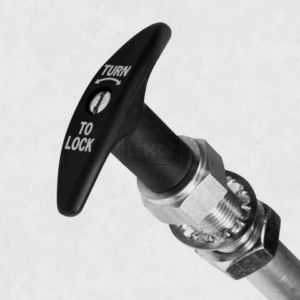
Push-pull controls allow the wire rope to move within a protective casing, i.e., conduit. These systems are used for cable-driven or cable-actuated controls within industrial, aviation, and marine environments.
Cable Railing Assemblies
Cable railing systems provide a strong and safe railing assembly without obstructing the view. They are modern, aesthetically pleasing, strong, sophisticated, adjustable, and extremely durable compared to other railing systems.
Bungee Cord Assemblies
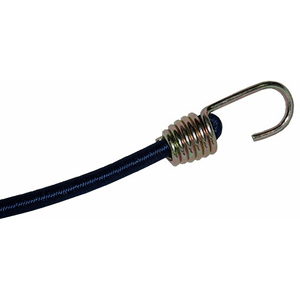
Lexco Cable also manufactures bungee cord assemblies, which are elastic cords meant for tie-downs, shock absorption, and light rigging where stretch is more important than strength.
How Do You Design a Wire Rope Assembly for Peak Performance?
All of the components listed above offer unique advantages for a variety of different applications. For custom wire rope cable assemblies, it’s vital to consider your project’s needs and design for peak performance. Your custom cable assemblies should consider:
- Minimum Breaking Strength (MBS)
- Working Load Limit (WLL)
- Materials
- Construction and flexibility
- End fitting type
- Termination method
- Critical Dimensioning and Tolerances
Minimum Breaking Strength (MBS) and Working Load Limit (WLL)
The minimum breaking strength, or MBS, of a custom wire rope cable assembly is the earliest force at which that rope will begin to fail based on a straight, gradual pull-test. This failure can be gradual or sudden, but a wire rope cannot withstand forces beyond its MBS without suffering some kind of destructive failure. Keep in mind that shock loads and angular loads may drastically reduce strength.
The working load limit, or WLL, is a fraction of the MBS (often 1/5 to 1/10 or more) and is defined as the limit at which a wire rope can operate indefinitely without any permanent damage. A 5:1 safety factor means the WLL is 20% of MBS. A 10:1 safety factor means the WLL is 10% of MBS. It is vital to define the MBS so that a proper safety factor can be applied to find the WLL.
Material Selection: Galvanized Steel Cable, Stainless Steel Cable, Coated Galvanized Steel Cable, or Coated Stainless Steel Cable?
When selecting cable or wire rope, consider both mechanical strength and corrosion resistance. While carbon steel can offer higher strength, it’s more susceptible to corrosion. Protective finishes like zinc galvanization or extruded plastic coatings are commonly applied to carbon steel cable to extend its service life in corrosive environments. Stainless steel provides superior corrosion resistance without requiring additional coatings. For stainless steel cable, the most commonly used grades are 302/304 and 316. In CNC-machined stainless steel fittings, grade 303 is sometimes used due to its superior machinability. It’s important to note that not all fittings retain 100% of the cable’s rated breaking strength; always refer to product-specific specification sheets for more performance details.
Construction and Flexibility
Wire ropes are designated by the number of strands in the wire rope and the number of wires in each rope strand. The higher the wire count, the more flexible it is relative to its respective diameter. Typical rigid strands include 1×7 and 1×19. Flexible aircraft cable constructions include 7×7 and 7×19. 7×19 is defined as 7 strands of 19 wires each. Flexible general-purpose wire rope constructions include 6×19, 6×25, 6×26, 6×36, and 6×37. Rotation resistant wire ropes include 8×19, 8×25, 19×7, 19×19, 34×7, 35×7.
End Fitting Type and Termination Method
Mechanical swaging is the most common, highest-strength, and most durable form of attaching end fittings to a wire rope. It provides a strong, permanent method of attachment. Zinc die-cast fittings are popular for high-volume applications, allowing for a wider range of end fitting geometries.
Critical Dimensioning and Tolerances
The most important dimensions and tolerances for designing a custom wire rope cable assembly are the diameter, bearing point length, length to centerline, and overall length. Push-pull controls also include a travel (stroke) dimension.
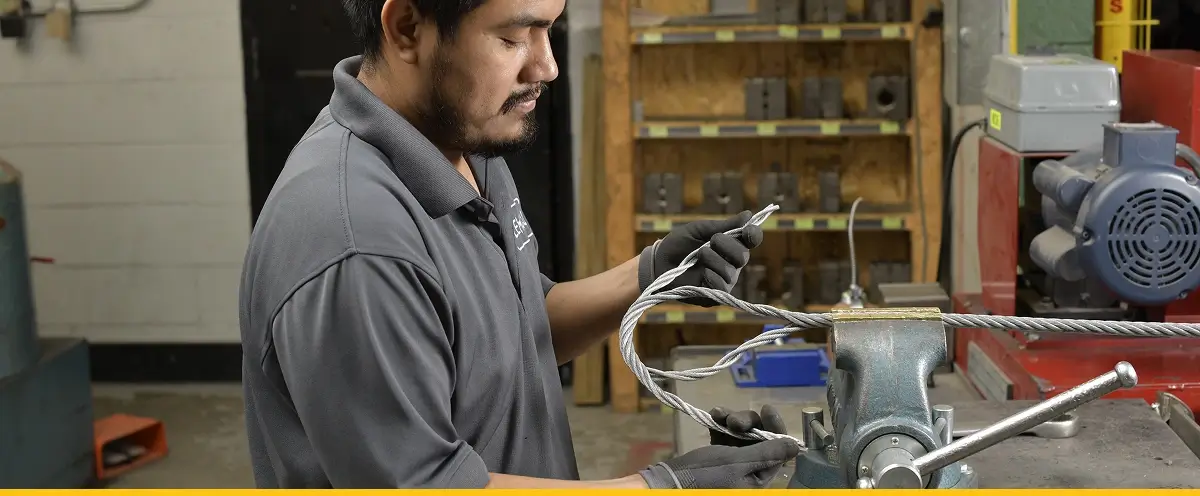
What are the Benefits of Choosing a Custom Fabricator Like Lexco Cable?
The following are the main reasons why you should choose a custom wire rope fabricator like Lexco Cable:
- Quality Control and Certification: Lexco Cable maintains multiple high-level certifications for quality and can reliably meet a flurry of military and federal specs as well as several Boeing specs, many ASTM standards, and several additional compliances. Together, their list of certifications and specs speaks of their dedication to consistent quality.
- Engineering Support: Lexco has a history of expertise in guiding customers through all steps of the design process. Through a robust consultation, Lexco can help you discover what you need and how it can be made.
- High-Volume, Repeatable Manufacturing: Lexco is capable of both high-quality and high-volume production, making them ideal for any application and any size order.
- Value-Added Services: Lexco offers several extra services, such as coiling, testing, and packaging. Coiling allows for compact storage and delivery, as well as other special uses that might require tightly coiled wire ropes.
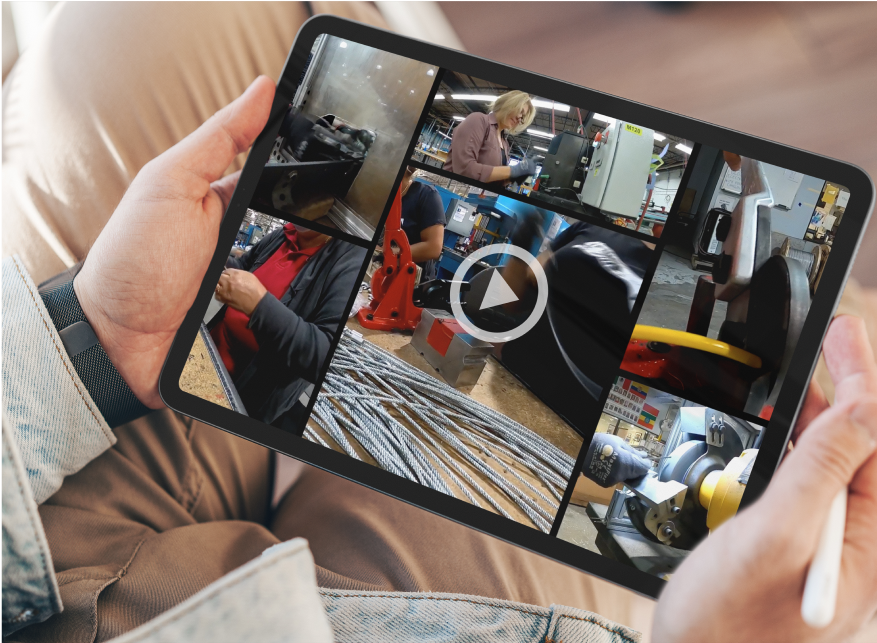
- Consolidation: Lexco Cable offers engineering, assembly fabrication, fitting manufacturing, and proof & pull-testing, among many other capabilities. This wide range of services streamlines supply chains, lowers costs, and reduces lead times for customers.
Ready to Start Your Custom Assembly Project?
Custom assemblies provide the exact fit, function, and reliability that off-the-shelf products simply cannot match. Whether your application requires high-strength static support, intricate motion control, or resistance to harsh environmental elements, a purpose-built assembly is the only way to ensure safety and performance. Lexco Cable offers the expertise, certification, and manufacturing capabilities to deliver these solutions at scale.
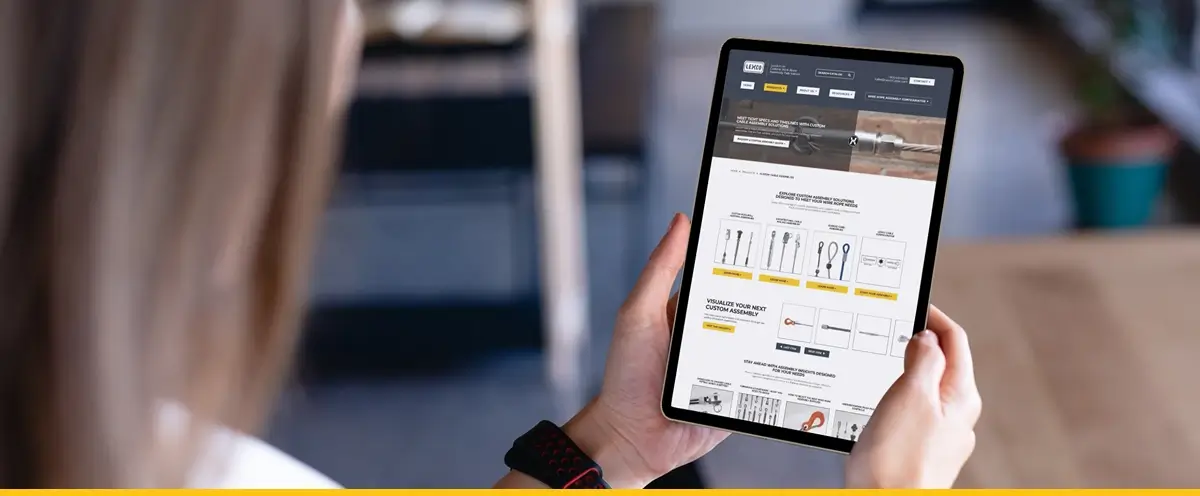
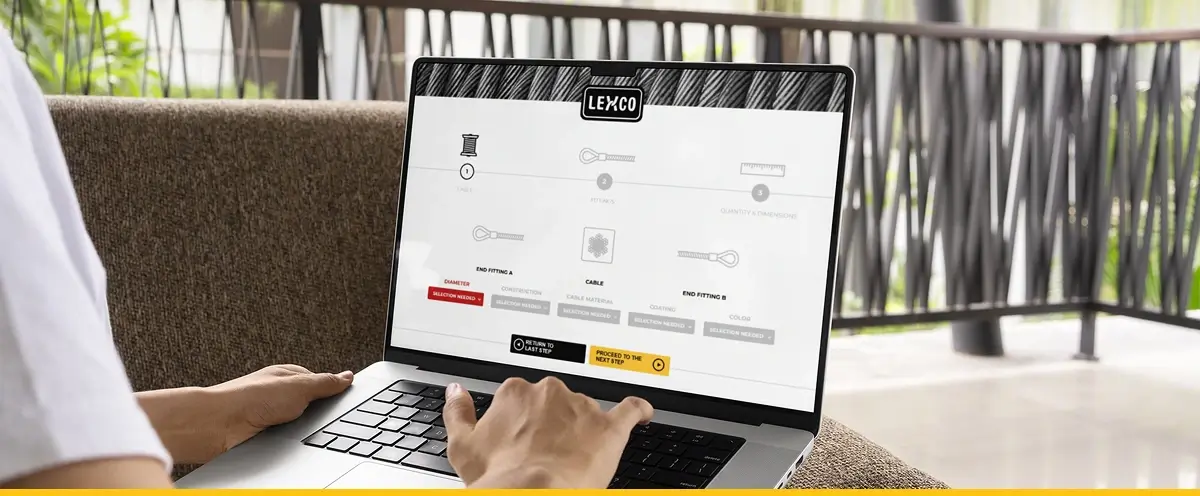
We offer multiple ways to move your project forward. You can request a quote directly through our website to begin the collaboration process. For those who know their exact specifications, our online tools streamline the process to get you the data you need quickly.
Get started today: Visit the Lexco Cable Configurator.
Frequently Asked Questions