


Wire Rope Fittings

Shop and request a quote for industrial wire rope and aircraft cable end fittings designed for secure attachment, load transfer, and assembly performance. Lexco Cable supplies swaged, crimped, clamped, speltered, and swageless fittings in multiple sizes and materials, available individually, in bulk quantities, or integrated into custom cable assemblies for OEM, construction, marine, and industrial applications.
https://www.lexcocable.com/media/susae1hk/1x19_uncoated.png

View Catalog

Industrial Wire Rope Fittings Supplier & Fabrication Partner

Lexco Cable supplies and installs wire rope and aircraft cable end fittings for contractors, OEM manufacturers, rigging professionals, marine operations, utilities, and structural applications. We provide:

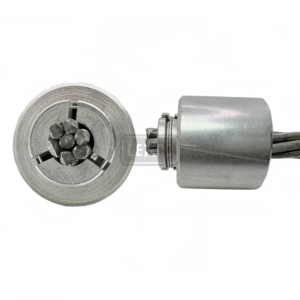
  • Swaged, crimped, clamped, spelter socket, and swageless end fittings
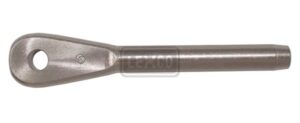
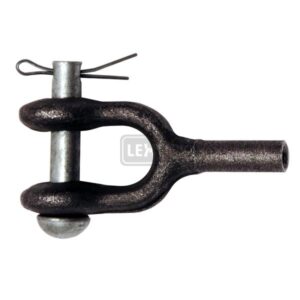
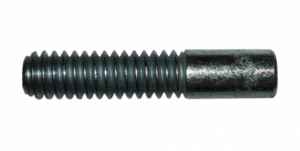
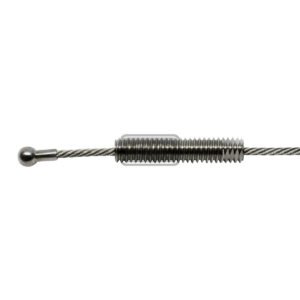
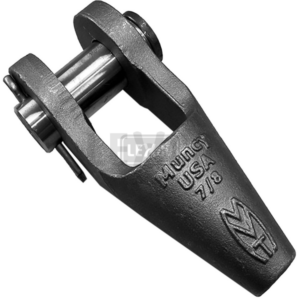
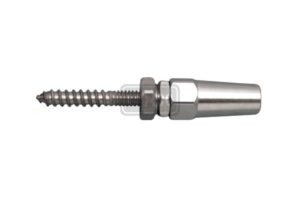
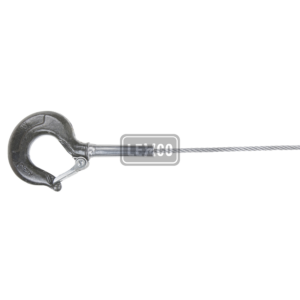
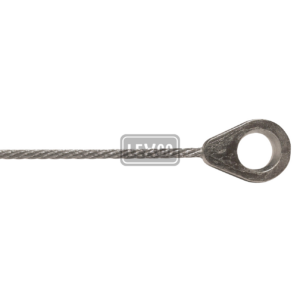
  • Eye ends, fork ends, threaded studs, balls, sockets, and specialty connectors
  • Multiple material and size options for diverse environments and load requirements
  • Bulk supply for production and field installation
  • Precision machine-swaged cable assemblies built to specification
  • Application guidance to ensure safe, secure, and code-appropriate attachment

Need help selecting the correct fitting or termination method?

Request a quote or contact our team for specification and fabrication support.”

Wire Rope End Fitting Types, Termination Methods & Selection Guidance

Swaged, Crimped, Clamped & Swageless Termination Methods

Choosing the appropriate termination method depends on your load requirements, installation environment, and whether the assembly needs to be permanent or field-adjustable.

Common termination methods include:

  • Machine-swaged fittings
    Used for maximum strength and permanent assemblies, offering high efficiency and consistent performance across production runs
  • Hand-crimped fittings
    Suitable for lighter-duty applications where field installation and basic tooling are required
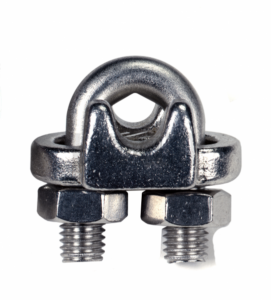
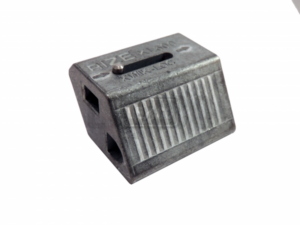
  • Clamped fittings (wire rope clips)
    Used for temporary or adjustable setups, though typically lower in strength efficiency compared to swaged options
  • Swageless fittings
    Ideal for field-installable systems, allowing installation without specialized swaging equipment
  • Spelter sockets
    Common in heavy-duty applications where maximum load capacity and secure termination are critical

How to choose the right method:

  • For maximum strength and long-term performance, machine-swaged or speltered fittings are typically specified
  • For field-adjustable or installation-friendly systems, swageless or hand-crimped options are often used
  • For temporary or non-critical applications, clamped fittings may be sufficient

Selecting the correct termination method ensures proper load transfer, safety, and long-term reliability for your cable assembly.

Common End Fitting Styles & Mechanical Functions

Engineers select end fitting styles based on load direction, connection type, and how the assembly needs to articulate or attach within a system.

Common fitting styles include:

  • Eye ends
    Used for fixed attachment points where a pin or shackle connects the assembly
  • Fork (jaw) ends
    Designed for articulated connections, allowing movement with a clevis pin
  • Threaded studs
    Ideal for direct integration into threaded components or tensioning systems
  • Balls and sockets
    Used in applications requiring secure anchoring or specialized load distribution
  • Connectors and specialty ends
    Designed for specific mechanical or structural attachment requirements

What to consider when selecting a fitting:

  • Load direction determines whether a fixed or articulated connection is required
  • Attachment geometry impacts how the cable connects to anchors, turnbuckles, or rigging hardware
  • System compatibility with existing hardware and components is critical
  • Material and size must align with load requirements and environmental conditions

Choosing the correct end fitting ensures proper load transfer, alignment, and long-term system performance.

Material Selection, Corrosion Resistance & Environment

Material selection should reflect exposure conditions, performance requirements, and expected lifespan of the assembly.

Common material options include:

  • Stainless steel fittings
    Provide strong corrosion resistance and are preferred for marine, outdoor, and high-moisture environments
  • Galvanized or plated fittings
    Offer a cost-effective solution for indoor or low-exposure applications

How to choose the right material:

  • For marine or high-moisture environments, stainless steel is typically required to prevent corrosion
  • For outdoor industrial applications, material choice should balance durability with cost
  • For indoor mechanical systems, plated or galvanized fittings may be sufficient

Key considerations:

  • Exposure to moisture, chemicals, or saltwater
  • Required lifespan and maintenance expectations
  • Tradeoff between initial cost and long-term durability

Selecting the right material ensures reliable performance, reduces maintenance, and extends the life of your cable assembly.

Integration With Custom Cable Assemblies & Machine Swaging

Machine-swaged assemblies provide consistent strength, precision, and repeatability for cable systems requiring reliable performance at scale.

Key advantages of machine swaging:

  • High strength efficiency for load-bearing applications
  • Precision attachment for consistent, repeatable results
  • Quality control across production runs and bulk orders

Pre-terminated assemblies offer:

  • Cables delivered ready for installation
  • Reduced on-site labor and installation time
  • Improved fit and finish compared to field-assembled systems

Ideal for:

  • OEM production and high-volume manufacturing
  • Projects requiring tight tolerances and repeatability
  • Applications where performance and consistency are critical

OEM manufacturers benefit from machine-swaged assemblies by improving production efficiency and ensuring uniform performance across every cable assembly.

Industrial & Commercial Applications for Wire Rope End Fittings

Wire rope end fittings are used across a wide range of industrial, structural, and mechanical applications.

  • Lifting and rigging assemblies
    Typically use swaged or speltered fittings for maximum strength and secure load handling
  • Structural or architectural tension systems
    Often use eye or fork ends with swaged terminations for clean, load-bearing connections
  • Marine and dock hardware
    Use stainless steel fittings and corrosion-resistant terminations for long-term durability
  • Utility and safety cable systems
    Commonly use threaded studs or connectors with field-installable or swaged fittings
  • OEM mechanical controls or linkages
    Use precision fittings and machine-swaged assemblies for consistent performance and integration

Request a Wire Rope Fittings Quote

Looking for specific wire rope end fittings or fully fabricated cable assemblies? Lexco Cable provides bulk fitting supply, precision machine-swaging, and custom-built cable assemblies for industrial and OEM applications.

Wire Rope Fittings FAQs

Can Extrusion Coated Wire Ropes Be Customized in Any Color?2026-02-12T18:47:59+00:00

Yes, one of the key features of extrusion coated wire ropes is the ability to match and create custom colors. This allows them to meet specific color requirements for projects, ranging from equipment manufacturers to safety equipment and retail displays. Lexco® Cable offers precision in color matching, ensuring the final product aligns with the brand’s identity and aesthetics.

Ready to get started? Request a quote.

What Are the Common Materials Used in the Manufacturing of Wire Rope Threaded Studs?2026-02-12T18:44:22+00:00

Wire rope threaded studs are typically made from materials like carbon steel, stainless steel, and alloy steel, each selected for its specific properties such as strength, corrosion resistance, and suitability for various environmental conditions.

Ready to get started? Request a quote.

What are wire rope threaded studs, and why are they important?2026-02-12T18:44:26+00:00

Wire rope threaded studs are crucial fastening components used in various applications to ensure structural integrity and reliability. They serve as the primary means of securing materials together across industries such as construction, automotive, aerospace, and marine.

Ready to get started? Request a quote.

What Stranding Constructions Does Mil-dtl-83140 Cover?2026-02-12T18:44:35+00:00

19×7 rotation resistant

Ready to get started? Request a quote.

What Stranding Constructions Does Mil-dtl-87161 Cover?2026-02-12T18:44:31+00:00

1×7

Ready to get started? Request a quote.

What Stranding Constructions Does Mil-dtl-83420 Cover?2026-02-12T18:47:16+00:00

7×7 bare

7×7 jacketed

7×19 bare

7×19 jacketed

Ready to get started? Request a quote.

Are There Different Types of Rotation-resistant Wire Rope?2026-02-12T18:47:21+00:00

There are 3 categories of rotation-resistant wire ropes organized by torque reduction.

  1. Category 1 is the most rotation-resistant and typical constructions are 34×7 and 35×7. Category 1 rotation-resistant wire rope may be used with a swivel.
  2. Category 2 is moderate and typical constructions are 19×7 and 19×19. Category 2 rotation-resistant wire ropes should not be used with a swivel.
  3. Category 3 has the least rotation-resistant of the 3 categories and typical constructions are 8×19 and 8×25. Category 3 rotation-resistant wire ropes should not be used with a swivel.

Ready to get started? Request a quote.

What Are the Different Wire Rope Constructions?2026-02-12T18:47:26+00:00
Classification # of Strands # of Wires # of Max Outer Wires
6×19 6 15-26 12
6×37 6 27-49 18
6×61 6 50-74 24
6×91 6 75-108 30
6×127 6 109+ 36

Ready to get started? Request a quote.

What Are the Differences Among Bright, Galvanized and Stainless Steel?2026-02-12T18:47:32+00:00

Bright wire rope is fabricated from wires that are not coated.

Rotation Resistant Bright wire rope is designed to resist the tendency to spin or rotate under load. In general, this rope is used as single part lines or situations where operating conditions require a rope that will resist cabling in a multipart system. The essential nature of rotation resistant rope designs impose certain limitations on their application and necessitate special handling requirements not encountered with other rope classifications.

Galvanized wire rope is zinc coated for corrosion resistance and has approximately the same pulling strength as Bright. In favorable environments, it can provide an economical alternative to stainless steel.

Stainless steel wire rope is made up of corrosion-resistant steel wires and is the highest quality wire rope available. It has approximately the same pulling strength as Bright or Galvanized rope and lasts the longest under harsh conditions such as saltwater and other acidic environments.

Ready to get started? Request a quote.

What Are the Rope Lay Options?2026-02-12T18:47:37+00:00

The finished rope has either a right or left-hand lay, which refers to the direction in which the strands were wrapped around the core.

Regular lay means the individual wires were wrapped around the centers in one direction, and the strands were wrapped around the core in the opposite direction.

Lang’s lay means the wires were wrapped around the centers in one direction, and the strands were wrapped around the core in the same direction.

The length of lay is measured as the distance in inches for one strand to go completely around the rope one time.

Ready to get started? Request a quote.

What is Wire Rope?2026-02-12T18:50:11+00:00

Wire rope is a flexible steel cord that is extremely strong. Typical uses for wire rope are: hoisting, towing, and anchoring heavy loads. The core is the foundation of a wire rope. The three most commonly used core designations are: fiber core (FC)independent wire rope core (IWRC), and wire strand core (WSC).

Ready to get started? Request a quote.


What Are the Factors Affecting the Selection of Wire Rope?2026-02-12T18:47:44+00:00

Strength-resistance to breaking
The wire rope should be strong enough to handle the maximum potential load, including safety factors.

Resistance to bending fatigue
Fatigue is caused by repeatedly bending rope around drums, sheaves, etc. A wire rope with strands made up of many small wires will be more resistant to fatigue, but less resistant to abrasion.

Resistance to vibrational fatigue 
Energy is absorbed via the end fittings or at the tangent point where the rope contacts the sheave.

Resistance to abrasion 
Abrasion occurs when a rope is dragged over the ground or other surfaces. A wire rope with strands made of fewer, larger wires will be more resistant to abrasion, but less resistant to fatigue.

Resistance to crushing 
During use, a wire rope may encounter crushing forces or be struck against hard objects. This can cause the rope to become flattened or distorted, resulting in premature breakage. Wire rope must have sufficient lateral stability to withstand the crushing pressures it may encounter. Regular lay ropes have greater lateral stability than Lang’s lay, and six-strand wire ropes have greater lateral stability than eight-strand ropes.

Reserve strength
Reserve strength is the combined strength of all the wires contained within the strands.

Ready to get started? Request a quote.

In What Industries Are Extrusion Coated Wire Ropes Commonly Used?2026-02-12T18:48:02+00:00

Extrusion coated wire ropes have versatile applications across numerous industries. They are used in the fitness industry, children’s play structures, rigging, marine applications, industrial designs, architectural accents, pet accessories, retail displays, safety equipment, and much more.

Ready to get started? Request a quote.

What is Extrusion Coating and How Does It Benefit Wire Ropes?2026-02-12T18:48:10+00:00

Extrusion coating involves jacketing wire ropes in a polymer layer, which enhances their durability and corrosion resistance. This process strengthens the ropes and allows for aesthetic customization through a range of colors, making them suitable for various environmental conditions and branding needs.

Ready to get started? Request a quote.

How Do You Measure Wire Rope Diameter?2026-02-12T18:48:13+00:00

Wire rope diameters are determined upon the measurement of a circle that just touches the outermost area of its strands. Usually, parallel-jawed calipers are used for this.

Ready to get started? Request a quote.

What Are the Four Characteristics to Consider When Choosing Wire Rope?2026-02-12T18:48:17+00:00

The four characteristics that someone should take into account when selecting wire rope for any project or assembly include strength, flexibility, corrosion resistance/ability to withstand wear, and ability to withstand distortion or crushing.

Ready to get started? Request a quote.

What Chemical Does Stainless Steel Type 316 Include That Stainless Steel Type 304 Does Not Contain?2026-02-12T18:48:21+00:00

Stainless steel type 316 comprises 2% Mo (molybdenum), while Mo is omitted from stainless steel type 304

Ready to get started? Request a quote.

What is the Best Wire for Corrosion Resistance?2026-02-12T18:49:56+00:00

Due to the metals used in the manufacturing process, stainless steel is one of the best types of wire rope for avoiding corrosion.

Ready to get started? Request a quote.

How Do You Protect Wire Rope Against Corrosion?2026-02-12T18:50:01+00:00

Regular lubrication, coatings, galvanization, and choosing the right type of rope for an assembly will help protect a wire rope against corrosion, rust, and degradation.

Ready to get started? Request a quote.

Will Wire Rope Rust?2026-02-12T18:50:05+00:00

In conditions that are salty or wet and humid, it is possible for wire rope to rust or corrode over time.

Ready to get started? Request a quote.

Go to Top